Battery Watt-Hour & Transport Calculator
Battery labels give capacity in mAh or Ah, but recyclers, couriers and airlines use watt-hours (Wh) to decide how a battery must be packed and transported. Enter the chemistry, voltage and capacity to convert to Wh, estimate the weight of a batch for your quote, and see the storage and transport precautions that apply before collection.
How to convert mAh to watt-hours
Watt-hours = amp-hours × volts. Divide mAh by 1,000 to get Ah first. A 5,000 mAh phone battery at 3.7 V is 5 × 3.7 = 18.5 Wh; a 12 V 100 Ah lead-acid battery is 1,200 Wh, or 1.2 kWh. For a battery pack, use the pack voltage printed on the label, not the voltage of one cell.
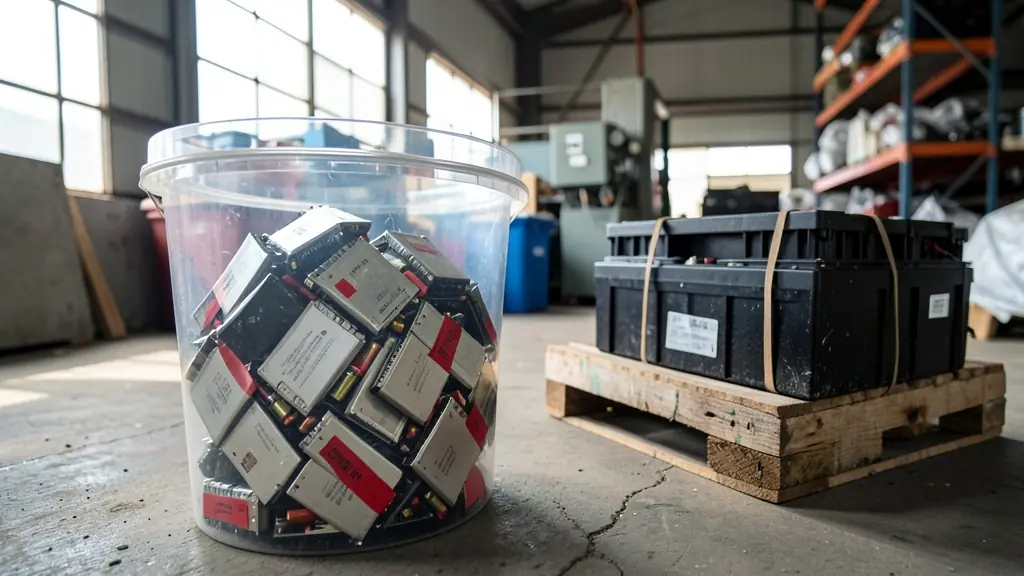
Why lithium batteries need special handling
Lithium batteries store a lot of energy in a small space. If they are crushed, punctured, short-circuited or overheated they can go into thermal runaway: a fire that is hard to put out and gives off toxic gas. Fires in waste trucks and recycling plants are often caused by lithium batteries thrown in with general waste.
For transport, lithium batteries are classed as dangerous goods (Class 9). Small quantities of small batteries can usually travel with simple precautions, but large packs, bulk loads and damaged batteries need proper packaging, labelling and a transporter licensed for dangerous goods. A reputable recycler will arrange this; mention the total Wh and any damaged batteries when you ask for a quote.
Safe storage before collection
- Tape the terminals of every loose battery, or put each one in its own plastic bag.
- Store them in a non-metal, lidded container in a cool, dry place away from flammable materials.
- Keep swollen, leaking or damaged batteries apart, in sand or a fire-resistant container, outdoors if possible.
- Keep lead-acid batteries upright and never drain or mix the acid.
- Never put batteries in general waste or the recycling bin.
Watt-hours of common batteries
| Battery | Voltage | Capacity | Energy |
|---|---|---|---|
| Smartphone battery | 3,85 V | 4,5 Ah | 17 Wh |
| 10,000 mAh power bank | 3,7 V | 10 Ah | 37 Wh |
| Laptop battery | 11,4 V | 4,5 Ah | 51 Wh |
| Cordless drill battery (18 V 5 Ah) | 18 V | 5 Ah | 90 Wh |
| UPS battery (12 V 7 Ah lead-acid) | 12 V | 7 Ah | 84 Wh |
| Car battery (12 V 60 Ah) | 12 V | 60 Ah | 720 Wh |
| E-bike battery (36 V 14 Ah) | 36 V | 14 Ah | 504 Wh |
| Solar battery (51.2 V 100 Ah LiFePO4) | 51,2 V | 100 Ah | 5 120 Wh |
Frequently asked questions
- How do I calculate battery Wh?
- Multiply the capacity in amp-hours by the voltage. For mAh, divide by 1,000 first: 10,000 mAh × 3.7 V ÷ 1,000 = 37 Wh.
- What is the 100 Wh limit for lithium batteries?
- Airlines and many transport rules treat lithium-ion batteries up to 100 Wh as small batteries with simpler requirements. Larger batteries, from about 100 Wh, have stricter packing, quantity and approval rules.
- Do recyclers pay for old batteries?
- Scrap dealers usually pay per kg for lead-acid batteries. Lithium batteries normally carry a handling fee, because of the cost of transporting and processing them safely.