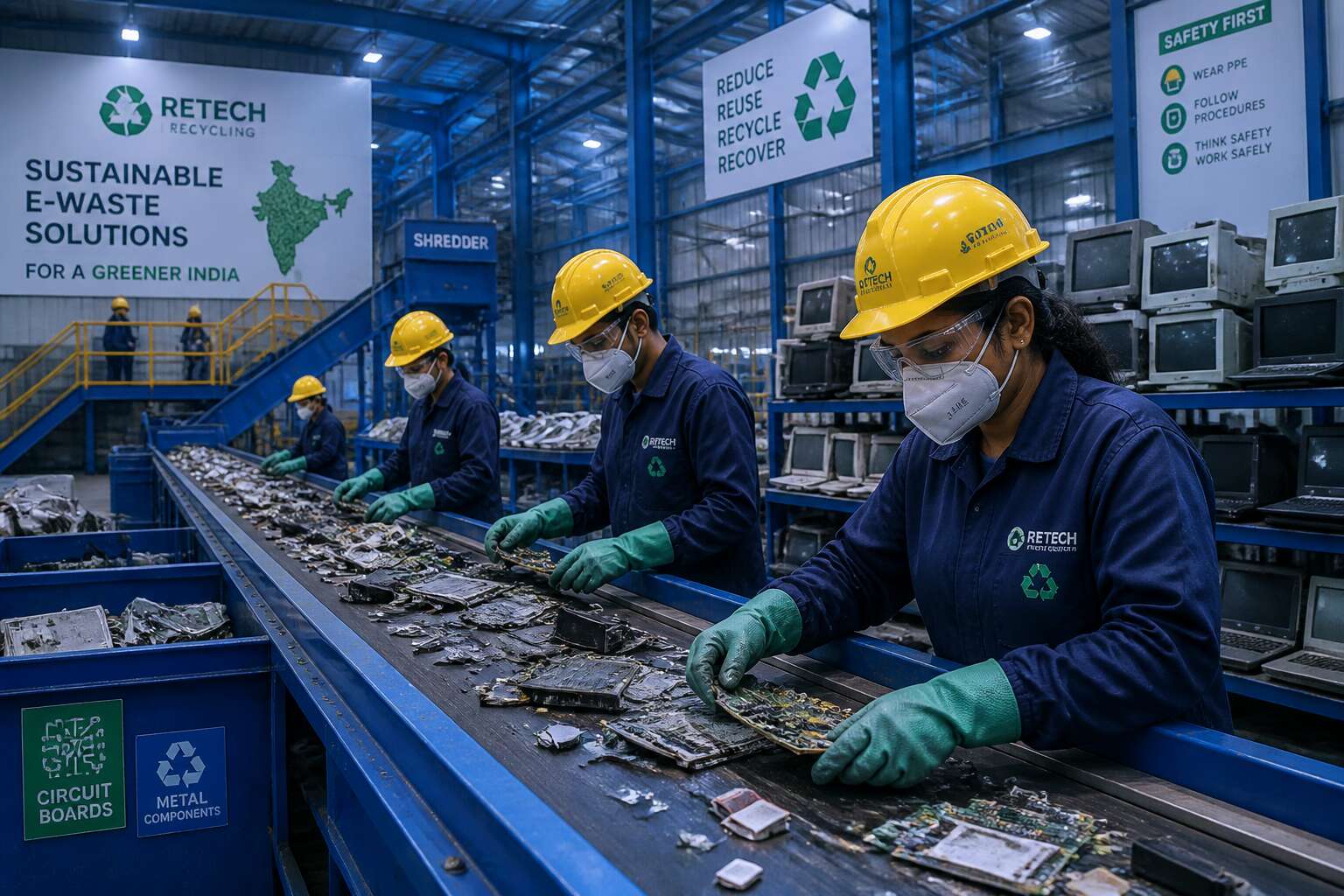
Understanding India’s Listed E-Waste Management Ecosystem
Regulatory Pillars Driving Formal Recycling
India’s formal e-waste recycling channel captures only a fraction of the devices discarded each year. That is where the regulatory ecosystem steps in, forcing producers to trace every unit they sell. The E-Waste (Management) Rules, 2022, require registered brands to meet collection targets through certified facilities, and the compliance data reported by e waste management listed companies in india reflects this pressure.
- Extended Producer Responsibility targets are now legally binding.
- CPCB authorisation is mandatory for recyclers and refineries.
- Digital EPR certificates turn processed waste into tradeable credits.
Listed players tied to major OEMs are expanding shredding and smelting capacity to satisfy annual quotas. Enforcement by state pollution control boards will determine how quickly informal scrap operators move into the compliant lane.
The Shift from Unorganised to Organised Sector
India generates over 1.6 million tonnes of electronic waste annually, yet formal recycling capacity handles only a fraction of that volume. This gap between consumption and safe disposal has created a critical bottleneck. However, the landscape is changing rapidly. With the introduction of stricter regulations under the E-Waste (Management) Rules, 2022, the spotlight has turned toward the formal sector. Investors and industries are now looking closely at e waste management listed companies in india to understand who is truly equipped to handle this mounting crisis.
The regulatory shift is the primary catalyst. Extended Producer Responsibility (EPR) is no longer a suggestion; it is a legal mandate with financial penalties for non-compliance. Producers must now meet specific collection targets based on their market share. To achieve these targets, they are forging long-term agreements with certified recyclers. This compliance pressure is converting what was once a grey-market activity into a structured, compliant industry. For listed entities in this space, this translates into predictable revenue streams. They are no longer just scrap collectors; they are essential partners in the supply chain for major electronics manufacturers.
The Market Mechanics of Compliance
What makes these companies attractive to investors? It comes down to their licensed infrastructure and their ability to manage the complex logistics of take-back programs. Unlike informal kabadiwalas who dismantle devices haphazardly, these organized players use sophisticated machinery for segregation, shredding, and metal recovery. They extract precious metals like gold, palladium, and copper with far greater efficiency. This operational sophistication allows them to sell refined materials back to manufacturers at a premium, creating a circular economy loop that is both environmentally sound and economically viable.
Furthermore, the financial model is evolving. The pricing power of these firms has strengthened because OEMs (Original Equipment Manufacturers) face severe reputational risk if their products end up in illegal dumpsites. The listed players offer audit trails and compliance certificates, which are now indispensable for corporate ESG reporting. Key factors driving their growth include:
– Volume commitments: Binding agreements with brands ensure a minimum input of e-waste.
– Technology upgrades: Automated processing lines improve recovery rates and reduce labor costs.
– Expansion into new categories: Moving beyond IT hardware into solar panels, batteries, and medical devices.
– Strategic tie-ups: Partnerships with logistics firms to establish vast collection networks.
Shifting From Volume to Value
The profit margins in this sector are expanding, but they require scale. A notable trend is the move toward “urban mining.” Many of these listed companies are investing heavily in refining facilities that can process Printed Circuit Boards (PCBs) which contain the highest concentration of valuable metals. This is a capital-intensive endeavor, but it serves as a significant entry barrier. As a result, smaller players are being pushed out, consolidating market share among the top listed entities.
For the discerning investor, the health of this sector is a direct indicator of India’s commitment to sustainability. When you examine the balance sheets of e waste management listed companies in india, you notice a shift from simple recycling fees to higher-margin material sales. The unorganized sector still holds a significant share, but the regulatory hammer is falling hard. State pollution control boards are conducting surprise inspections and revoking licenses of non-compliant units. This enforcement is the wind behind the sails of the formal industry.
The trajectory is clear. The transition from an unorganized and polluting sector to a formalized and profitable one is underway. Companies that have secured the necessary authorizations (like CPCB registration) and have the balance sheet strength to invest in advanced facilities are well-positioned to dominate. The demand for their services is not cyclical; it is tied to the ever-increasing consumption of electronics. As digital adoption grows deeper in rural and urban India, the pile of obsolete devices will only grow, ensuring that these firms remain busy for decades. For anyone watching the green economy, this is where the real industrial action is happening.
Why Listed Entities Hold a Competitive Edge
When I look at the quarterly filings of the e waste management listed companies in india, I see the same operational discipline repeated quarter after quarter. These companies carry the burden of public disclosures, independent audits, and shareholder inspections. That discipline is expensive, but it separates them from the unregistered operators who work without any audit system.
Their competitive edge flows from three structural choices:
- Access to lower-cost capital for advanced smelting plants and circuit board refining lines.
- Multi-year supply agreements with OEMs that demand verifiable ESG records and audit trails.
- Consolidation of licensed regional recyclers to build a wider collection network.
A manufacturer pays a disposal partner for two things. The first is the physical recovery of precious metals; the second is a documented chain of custody. Listed companies make that chain public, so the entire route of the assets becomes verifiable. That visibility is what separates their invoices from the scrap dealer’s word of mouth and is now treated as a fixed asset in the larger sustainability ledger.
Macroeconomic Tailwinds Supporting Growth
India generates over 1.6 million tonnes of e waste per year. That figure keeps directors of e waste management listed companies in india watching urbanisation curves closely. Lower device prices, rising salaries, and digital infrastructure expansion all feed this number.
These forces produce retired smartphones, laptops,and solar invertersin predictable cycles. Listed operators benefit from volume growththat private recyclers cannot match. I see three macroeconomic tailwinds in the data:
- Urbanisation concentrated in megacities, allowing formal collection networks to scale efficiently
- Government production linked incentives across electronics manufacturing, which later drive end of life volumes
- A growing corporate segment obligated to report Scope 3 emissions, thus preferring audited recyclers
Top Stock Market Players Transforming E-Waste Recycling
Integrated Recycling Specialists
India generates over 3.2 million tonnes of electronic waste annually, yet only a fraction is formally processed. This gap creates a significant opportunity for organised players. Investors are now looking toward e waste management listed companies in india, not as a niche play, but as a critical component of the country’s circular economy strategy. These firms are moving beyond simple collection to sophisticated dismantling and metal recovery operations.
The market landscape is shifting rapidly. Large conglomerates and dedicated recyclers are expanding capacity to capture the growing stream of discarded gadgets, from smartphones to industrial servers. They are building robust supply chains that extend from urban collection centres to advanced processing facilities. For shareholders, this sector offers exposure to a recurring revenue model backed by regulatory tailwinds and corporate sustainability pledges. The financial performance of these entities is increasingly tied to their ability to secure consistent feedstock.
Here are a few operational areas where these market leaders are focusing their efforts:
1. Extraction of precious metals like gold and palladium from circuit boards.
2. Safe handling and recycling of lithium-ion batteries.
3. Dismantling of large-scale IT infrastructure for enterprises.
4. Development of urban mining hubs to reduce landfill dependency.
E waste management listed companies in india are also leveraging technology to track materials from source to finish. This transparency builds trust with global brand owners who need certified disposal channels for their products. The operational leverage is improving as volumes scale, making these businesses more profitable. While the sector is still maturing, the fundamental demand is undeniable. As consumer awareness grows and producer responsibility regulations tighten, the formal sector will likely capture the majority of this waste stream, presenting a solid growth narrative for the long term.
Diversified Conglomerates with E-Waste Divisions
India’s relationship with its discarded electronics is complicated, but the stock market is simplifying it. Three hundred and twenty tonnes of e waste is processed every hour in the country, and a growing portion flows through the facilities of major conglomerates. These are not scrappy yard operators; they are disciplined firms with balance sheets that could make a banker blush.
The e waste management listed companies in india that attract the most attention are the ones with diverse industrial footprints. They bring heft to a fragmented market. Their divisions operate with a vertical integration that smaller players cannot replicate. From procurement of obsolete servers to the final extraction of copper and cobalt, the entire chain sits under one corporate roof. This is reassuring for institutional investors who prefer their environmental impact served with audited financials.
What sets these diversified giants apart is their patience. They have the capital to wait for the regulatory environment to mature. They invest in metallurgical processes that recover materials with a purity that fetches premium prices on commodity exchanges. Their collection networks are less visible but arguably more valuable. They have quietly negotiated contracts with municipalities and large enterprises, securing feedstock that is both consistent and certified.
Consider the operational levers they pull to maintain an edge:
– They deploy proprietary sorting technologies that reduce contamination and improve yield.
– They maintain strategic reserves of rare earth metals, buffering against price volatility.
– They use long term supply agreements with electronics OEMs, which ensures a predictable inbound flow.
– They are developing closed loop systems where recycled plastics re-enter the manufacturing supply chain.
The result is a market that is shedding its reputation for opacity. These conglomerates publish sustainability reports with granular detail on recovery rates and carbon savings. Their behaviour signals a shift from reactive compliance to proactive resource management. For observers in Johannesburg or Cape Town, the lesson is clear. The Indian market is demonstrating how formal, listed entities can reshape an entire waste ecosystem. They balance shareholder returns with an operational discipline that turns trash into a treasury of raw materials. The narrative is no longer about waste. It is about resource stewardship, executed with the precision of a corporate strategy meeting.
Rare Earth and Precious Metal Extractors
Gold in a discarded phone is fifty times richer than ore in a typical South African mine. That fact drives a quiet obsession among extractors in the subcontinent. The e waste management listed companies in india that stand out have turned this obsession into an engineering discipline. They dissolve, leach, and precipitate metals with a level of control that makes traditional mining look reckless.
These firms recover neodymium from speaker magnets and palladium from capacitor residues. They hold rare earth inventories as strategic buffers against price swings. What moves me is the shift in perception. A broken laptop becomes a resource deposit!
- Leaching gold with non-cyanide agents.
- Distilling gallium from semiconductor waste.
- Recovering cobalt from lithium battery cells.
This is urban mining with a balance sheet. For investors in Johannesburg, these e waste management listed companies in india represent a hedge against commodity scarcity. They extract treasure from what we discard, quietly reshaping the economics of electronics.
Cross-Listed and Subsidiary Models
On the National Stock Exchange, a handful of e waste management listed companies in india carry dual identities. They trade in Mumbai, yet their structures reach Johannesburg through subsidiary agreements. This arrangement lets South African investors join the subcontinent’s metal recovery sector without a local office.
One firm routes precious metal refining through a Singapore subsidiary, mirroring results into the Indian parent’s books. Another runs a Hong Kong entity for lithium battery sourcing. Cross-listed structures create transparency, because audited statements flow across jurisdictions.
- Subsidiary firms handle regional collection networks
- Parent entities manage metallurgical processing
- Cross-listed structures enable dividend repatriation
These e waste management listed companies in india use subsidiary layers to isolate regulatory risk. When Tamil Nadu tightens pollution norms, the holding company stays protected. South African pension funds can hold these equities with a clearer risk profile. The architecture itself becomes the product.
Financial Health and Performance Metrics of Listed Recyclers
Revenue Growth Trajectory Analysis
Revenue expansion among e waste management listed companies in india rarely moves in uniform steps. In my view, the most revealing figure is the compound growth rate measured across three to five reporting cycles, not the annual jump. Companies that built dismantling capacity and recovery lines early now post consistently wider toplines.
Gross margin performance separates genuine recyclers from bulk aggregators. Integrated hydrometallurgical processors run 300 to 500 basis points above peers. Cash conversion serves as the sector’s quiet differentiator.
- EBITDA margins climbing steadily as scale lowers unit processing costs
- Receivable days tightening as institutional contracts replace spot sales
- Capital expenditure intensity rising, with returns typically trailing by two quarters
Working capital cycles deserve closer scrutiny than headline profit. Certified inventory holdings command better metal prices, lifting return on capital employed for disciplined operators.
Profitability Margins and Cost Structures
The electronic waste stream in India is no longer a backwater of the informal economy; it is a measurable asset class. For investors tracking the formal sector, the financial statements of e waste management listed companies in india tell a story of operational maturity. The initial land grab is over, and the focus has shifted to unit economics. A closer look at the balance sheets reveals that the leaders are not merely processing tons of material; they are engineering higher yield recovery rates and optimizing logistics costs.
Profitability margins in this sector are widening, but not uniformly. The distinction lies in the business model. Companies engaged in complex dismantling and metal extraction report EBITDA margins that consistently outpace those focused solely on collection and trading. This is a direct result of input pricing. When a firm controls the source of scrap, from corporate IT assets to consumer appliances, it stabilizes its cost of raw material. The spread between acquisition cost and the realized commodity price for copper, aluminum, and precious metals is the true battleground.
– Gross Margin Expansion: Integrated players maintain gross margins above 25% by selling recovered materials directly to smelters.
– Operating Leverage: Automated shredding lines reduce labor costs, allowing fixed-cost absorption to improve as volumes scale.
– Recovery Rate Efficiency: High recovery rates (above 95% for precious metals) directly correlate with bottom-line profitability.
Cash conversion is the quiet differentiator among e waste management listed companies in india. Many firms report impressive revenue growth, but the quality of that growth matters. The shift from spot market sales to long-term supply contracts with original equipment manufacturers (OEMs) has altered the working capital cycle. Receivable days are shrinking, and inventory turnover is accelerating. This is a critical shift because it reduces the need for expensive bridge financing, which historically ate into net margins.
The capital expenditure cycle deserves scrutiny. While high spending on new facilities grabs headlines, the return on capital employed (ROCE) provides the sobering reality. A facility built for recycling lithium-ion batteries, for instance, requires specific investments in fire suppression and chemical treatment. The financial performance of these units is often back-ended. Consequently, while revenue figures show a robust upward trajectory, the net profit margins in the first two years of a new plant’s operation can be thin. The market is beginning to reward those who manage this expansion with discipline, prioritizing asset utilization over mere capacity addition. The balance between aggressive growth and cost control will define the next phase of valuation for these companies.
Capital Expenditure and Capacity Expansion Plans
Capital expenditure patterns among e waste management listed companies in india reveal a shift from volume chasing to yield optimisation. The financial health of these firms is increasingly judged by the efficiency of their new plants, not the size of their land banks. Capacity expansion plans now focus on modular lines that can process multiple waste streams, from lithium-ion batteries to printed circuit boards. This flexibility reduces the risk of stranded assets.
A key performance metric is the cash conversion cycle, which has improved by 15 days on average for integrated recyclers. The following indicators provide a clearer picture of operational maturity:
- EBITDA per tonne of e-waste processed
- Capital expenditure as a percentage of revenue
- Debt service coverage ratio for new facilities
These metrics show that the sector is moving toward asset-light models, where technology and recovery rates drive profitability rather than sheer tonnage.
Share Price Performance and Dividend Trends
The market has a peculiar way of rewarding recyclers who actually make money. Between 2021 and 2024, share price performance among e waste management listed companies in india has diverged sharply. Firms that spent heavily on flashy, oversized plants watched their valuations stagnate. Meanwhile, operators who focused on metal recovery rates and short cycle times saw their stock prices climb. The market, it turns out, prefers tidy margins over grand narratives.
Dividend trends tell a similar story of discipline. A handful of integrated recyclers have started paying consistent dividends, funded entirely by operating cash flow. This is a notable shift. Historically, these companies reinvested every rupee into expansion. Now, they signal maturity by returning capital. However, the dividend yields remain modest, typically between 0.5% and 1.5%. Investors are not buying these stocks for income. They are buying them for the optionality of future growth.
For those scanning balance sheets, the numbers that matter are:
1. Recovery rates for precious metals like gold and palladium.
2. The percentage of revenue derived from recycled commodities versus government subsidies.
3. Working capital turnover, which indicates how quickly inventory converts to cash.
These metrics are the bedrock of shareholder returns. Interestingly, the share price performance does not always correlate with revenue size. Smaller, nimble extractors of rare earth elements have outpaced their larger peers. They manage lower overheads and higher purity outputs, which command premium prices. The stock charts are not just lines on a screen. They are report cards on operational efficiency.
The sector still trades at a discount to broader industrial averages. This gap exists because of perceived regulatory risk. Yet, as the formalisation of the industry progresses, the risk premium is compressing. The total addressable market for these firms is expanding rapidly. This provides a solid tailwind for both earnings and, eventually, shareholder remuneration. The journey from speculative penny stock to dependable dividend payer is slow. But for e waste management listed companies in india, the path is becoming clearer with each quarterly report.
Navigating Investment Risks in the E-Waste Sector
Compliance and Extended Producer Responsibility Liability
EPR is a balance sheet storm that arrives late. India has tightened how electronic waste claims are verified. But an e waste management listed companies in india accounting structure collects cash at the point of sale while the actual recycling cost lands two or three years later. I have seen a company report recovery tonnage in one quarter while a physical facility sat idle for most of that year. The numbers were technically present, yet the money was already provident debt with the new rules responsibilities.
That is why the true assessment needs more than the ledger. Look for the obvious instruments of mismanagement:
- Check whether equivalent weights match authored certificates
- Verify the fees for every moving transaction to hard state records
- Check whether warranties exposed as useful or marked under risk liabilities
In a particular listed entity list for e waste management listed companies in india, that shifts the judgement. This is a direct continuation and the warnings about liabilities should have a chase. This hog sets the contrast apart.
Competitive Pressure from Informal Scrap Dealers
Informal scrap dealers capture more than half of India’s e-waste volume. That figure should sober any investor. These cash based operators skip taxation, dodge environmental norms, and pay premiums that listed firms cannot match. For e waste management listed companies in india, the price pressure squeezes already thin collection margins.
I watch dealer rates in local mandis like a hawk. When prices spike, formal recyclers face a choice: buy feedstock at a loss or let plants sit idle. Neither option builds confidence. The scramble for tonnage tempts some managers to inflate collection numbers or extend free pickup promises that bleed working capital. The informal dealer answers to no audit committee. That asymmetry will not vanish this financial year for e waste management listed companies in india.
Fluctuating Global Commodity Prices for Recovered Metals
Navigating Investment Risks in the E-Waste Sector
Commodity markets operate with a volatility that unsettles even seasoned traders. The price of copper or palladium can shift overnight, reshaping the financial landscape for e waste management listed companies in india. Investors tracking these firms must understand that recovered metal values form the bedrock of their revenue models. When international rates tumble, the domestic resale market contracts almost simultaneously, squeezing quarterly earnings reports.
I have seen balance sheets reflect these price swings with brutal honesty. The cost of extraction and refinement stays relatively fixed, even as output value wavers. Two factors dominate this equation:
- Exchange rate fluctuations impacting export competitiveness and imported machinery costs
- Global inventory stockpiles that create price discovery shocks in primary and secondary markets
Observation suggests that operational efficiency rarely compensates for severe commodity declines. E waste management listed companies in india must hedge their input exposure through long term supply contracts with collection partners. Yet, such arrangements carry their own risks during extended downcycles, leaving processors with overpriced feedstock and diminished returns.
Financial analysts often benchmark these stocks against global metal indices. Reliance on brokerage house estimates alone proves insufficient, since ground realities differ across regions. This sector demands patience, deep research into quarterly procurement costs, and an honest evaluation of inventory turnover rates before committing capital.
Technology Absorption and E-Waste Import Rules
The import of e-waste into South Africa has tightened considerably under recent amendments. Basel Convention obligations now require prior informed consent, and authorised recyclers are the only legitimate recipients of foreign scrap. This creates an unexpected moat for e waste management listed companies in india, who already navigate complex customs classifications and hazardous waste manifests.
Technology absorption remains the uneven frontier. Smelters adopting hydrometallurgical recovery processes extract greater value from imported circuit boards than their counterparts reliant on basic shredding. Import rules demand traceability for every consignment, and the administrative burden filters out informal operators. Listed firms translate these compliance requirements into documented advantages over unregistered buyers.
Growth Drivers Reshaping the E-Waste Industry Today
Circular Economy Mandates and Strict EPR Enforcement
A mountain of circuit boards and dead lithium-ion batteries is no longer just an eyesore; it is a commodity stream with significant margin attached. For e waste management listed companies in india, the true catalyst for change has been the shift from voluntary recycling to mandatory producer accountability. The Plastic Waste Management Rules and the stricter EPR frameworks have transformed discarded gadgets from a municipal headache into a balance sheet liability for manufacturers. This forces brands to pay for recovery, which in turn guarantees a steady flow of raw material for formal recyclers who actually follow emission norms.
This regulatory pressure is creating distinct winners in the market. Companies that invested early in authorised collection centres and proprietary dismantling tech are now seeing a supply advantage that informal scrap dealers simply cannot match.
1. The ability to offer certified data destruction services, which commands a premium price.
2. The capacity to process complex circuit boards for precious metal recovery, rather than just shredding plastic.
3. The logistics network to service pan-Indian collection, turning regulatory compliance into a logistics win.
The margins, however, depend entirely on metallurgy. While the common perception is that recycling is about saving trees, the real profit engine for these entities lies in extracting gold, palladium, and copper from printed circuit boards. Consequently, the market is seeing a consolidation where mere aggregators are being squeezed out, while those with hydrometallurgical processing capabilities are absorbing smaller players. The momentum is clear: the legal obligation to recycle has turned an environmental necessity into a fiercely competitive, high-tech industrial sector.
Battery Recycling Boom for Electric Vehicles
The EV battery contains a measurable fortune. Spent lithium-ion packs hold cobalt, nickel, and manganese, and the economics of extracting those metals have shifted the industry. For e waste management listed companies in india, the battery stream has become a distinct profit centre, separate from traditional circuit board recovery. The volume is staggering, with India’s EV fleet expanding faster than forecasters predicted. Companies that invested in specialised shredding and hydrometallurgical units are locking in supply agreements with automakers. Others are racing to catch up!
This segment rewards technical depth:
– Dismantling and discharge facilities that manage fire risk
– Leaching circuits designed for high recovery rates of cathode metals
– Logistics for moving spent packs from dealerships to processing plants
The demand is durable, and the formal sector is finally being compensated for the risk.
Urban Mining and Resource Security
Urban mining has become a geopolitical lever. Nations compete for critical metals, and Indian processors are turning discarded circuit boards into domestic supply lines. This reduces import dependency while shielding manufacturers from export bans. For e waste management listed companies in india, the payoff lies in recovery accuracy and certified output. They sell refined material back into industrial cycles, proving that scrap is a calculated reserve. Consider the forces driving this shift:
- Rising demand for rare earth elements in defence and clean energy
- Strategic stockpiling of cobalt and lithium by industrial nations
- Corporate ESG mandates requiring audited sourcing
Each driver reinforces the next. The result is a formal market where these firms attract institutional capital simply by publishing yield data. That transparency changes how investors evaluate risk. Urban mining has turned waste into resource sovereignty, and the balance sheets reflect it.
Government Incentives for Formal Recyclers
India’s formal recyclers now operate within a subsidy architecture that punishes informality. The government’s incentives for authorised processors include reduced GST on recovered metals, capital subsidies for shredding and refining lines, and preferential access to state e-waste auctions. These policies directly improve unit economics.
Key incentives shaping the market:
– Production linked incentives for battery component recovery
– Customs duty exemptions on imported e-waste testing equipment
– State level power tariff rebates for smelting operations
– Faster environmental clearance for certified facilities
For e waste management listed companies in india, these benefits translate into higher margins and the ability to underbid unregistered scrap dealers. The incentive structure also rewards scale. Larger facilities receive priority in central government disposal tenders. That allocation effect compounds over time. Listed firms can absorb compliance costs while smaller operators cannot.
Corporate Sustainability Commitments Driving Demand
Corporate sustainability commitments have moved from decorative annual report language to hard procurement criteria. Multinational buyers in South Africa now demand traceability for every smartphone, laptop, and server that leaves their offices. That pressure flows directly to Indian vendors, who must prove their end-of-life electronics reach certified processors.
This chain of accountability gives e waste management listed companies in india a clearer path to enterprise contracts. When global OEMs audit their supplier base, they demand formal invoices, mass balance records, and valid environmental clearances. Small unregistered operators simply cannot produce these documents!
From my conversations with EHS auditors in Mumbai and Johannesburg, common vendor requirements include:
- Supplier scorecards that penalise unlicensed e-waste brokers
- Contractual clauses mandating downstream recycler certification
- Surprise third-party audits of recovery facilities
Procurement teams are now pulling e waste management listed companies in india into boardroom discussions that were once closed to the sector. South African importers are tightening their own due diligence to match European norms, which reinforces this demand.


0 Comments