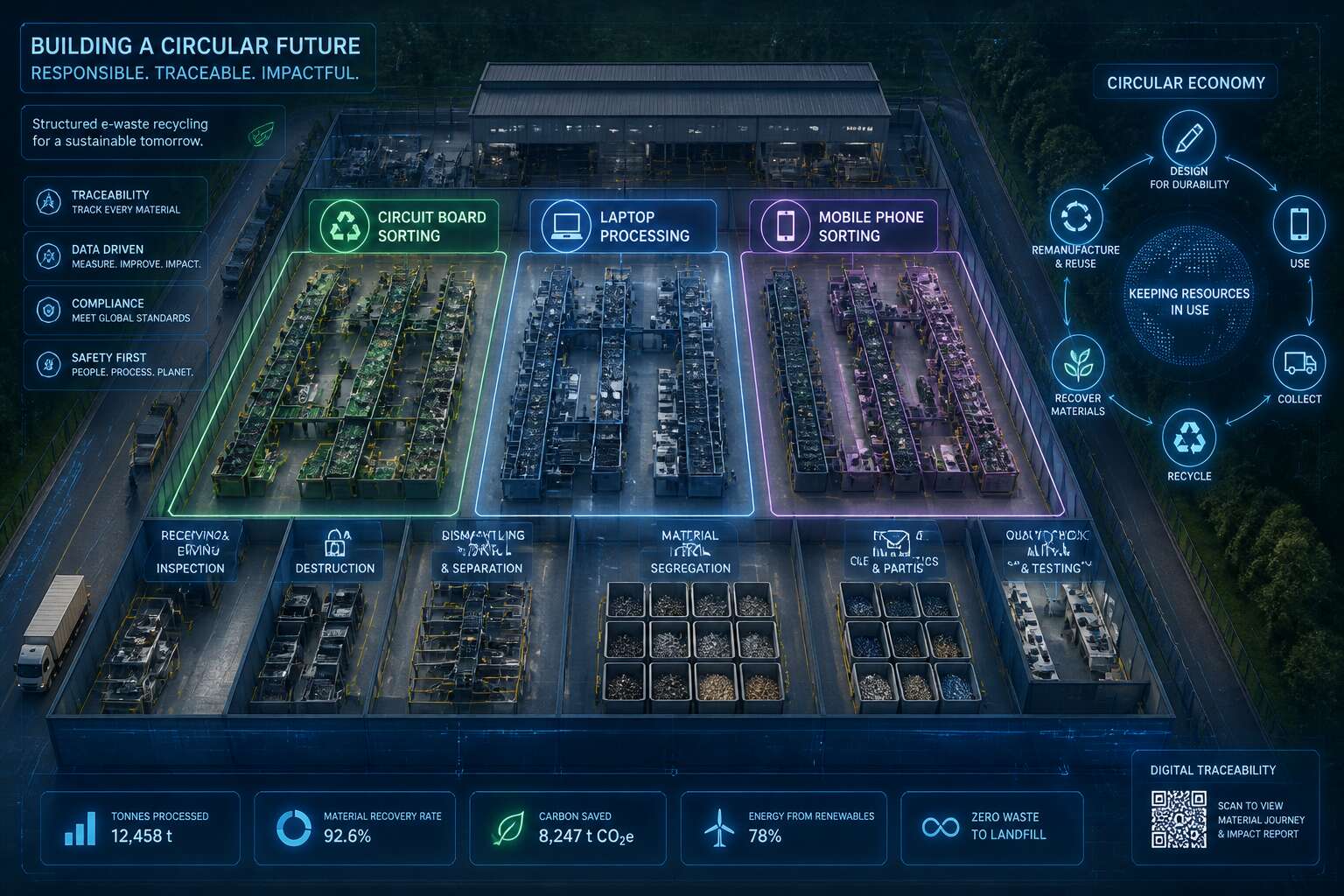
Why Structured E-Waste Handling Matters
South Africa generates over 360,000 tonnes of e waste every year. Most of it ends up in landfills, where lead and mercury seep into the soil. A proper e waste management framework changes that trajectory entirely.
Structured handling means every device is tracked from the moment it lands at a collection point. That matters because informal recyclers often strip out only the copper and discard hazardous boards. A framework imposes order on that chaos. It assigns responsibility, defines processing standards, and guarantees data destruction.
Without structure, recovery rates stay abysmal and surrounding communities carry the health cost. Structure also makes compliance measurable, letting regulators spot gaps before they widen.
That is why the e waste management framework forms the backbone of any credible recycling programme. It is no administrative luxury. It is the divide between dumping for profit and building genuine circularity.
Key Components of a Comprehensive E-Waste Strategy
South Africa generates nearly 360,000 tonnes of e waste each year, yet only a sliver enters formal recycling channels. That gap shows why we need a coherent e waste management framework. The strategy must rest on three components: collection infrastructure, data security, and producer responsibility.
- Collection infrastructure means accessible drop off points in every municipality, including low income areas.
- Data security requires certified destruction of hard drives and memory chips.
- Producer responsibility shifts the financial burden back to manufacturers.
A comprehensive strategy also needs enforcement mechanisms. Without penalties for illegal dumping, an e waste management framework becomes a suggestion rather than a law. This is where municipal officials and national regulators must coordinate. In my experience, this coordination is the hardest part. The rewards are real for communities when the system actually works.
Building an Operational E-Waste Action Plan
South Africa is generating electronic waste at an alarming rate, with estimates suggesting it now surpasses 360,000 tonnes annually. Most of this heads straight to landfills, leaking toxins into the soil while valuable metals sit unrecovered. Building an operational action plan starts by acknowledging this reality.
A solid e waste management framework does more than dictate where old monitors go. It forces you to map the entire lifecycle of your equipment. This means tracking devices from the moment they arrive on your loading dock until they are dismantled for parts. Without that trail, you are merely guessing at your footprint. An effective framework creates accountability at every single stage.
Consider what your plan must address immediately:
– A secure data destruction process that leaves no room for doubt
– Designated collection points that staff actually know about
– Contracts with accredited recyclers who operate above board
– Clear reporting lines so progress is measurable
The most successful programmes treat this as a daily operational task, not a once yearly cleanout. When you embed these elements into your standard workflow, compliance becomes routine rather than a scramble. That is the difference between a policy on paper and a system that runs your business. Your e waste management framework should reflect that distinction.
Audits are where good intentions meet reality. Inspect your waste bins randomly to see if anyone is still dumping batteries in with food scraps. Track the weight of e waste collected each quarter and compare it to your procurement records. If they do not align, you have leakage somewhere. A framework only works when it survives contact with your actual daily operations.
Treat your plan as a living system, one that adapts as your business grows and regulations tighten. The cities and provinces in South Africa are slowly tightening their own rules, so what passes today may not hold next year. Build review cycles into your schedule and revise with intention. A static document is a liability; a responsive framework is your shield.
Monitoring, Reporting, and Optimization
The numbers are staggering. South Africa generates nearly 360,000 tonnes of electronic waste each year, yet only a sliver of that is formally collected and recycled. For a nation grappling with both resource scarcity and environmental degradation, this isn’t just a missed opportunity. It’s a mounting crisis that demands a structured response. A robust e waste management framework isn’t a static document, it’s a living system that thrives on dedicated oversight.
The first pillar of that system is monitoring. You can’t manage what you don’t measure. I’ve seen community collection drives in Gauteng where the enthusiasm is real, but the data is sparse. Without granular tracking, we are flying blind. Monitoring means knowing precisely what types of materials are coming in, their volume, and their final destination. It involves validating that downstream partners are audited and compliant. These are the foundational numbers that tell you if your operation is genuinely a solution or merely a relocation of the problem.
Key monitoring considerations for your framework include:
– Tracking the mass and categorization of e-waste streams for accurate data.
– Auditing the chain of custody to prevent leakage into the informal sector.
– Verifying data destruction milestones for all storage devices.
– Calculating the recovery rate of valuable ferrous and precious metals.
Reporting is where that raw data transforms into actionable intelligence. It’s the difference between having a stack of spreadsheets and having a clear picture of your business. Strong reporting protocols turn raw numbers into a compelling narrative for investors and regulators. This discipline also safeguards your reputation. In this industry, proof is the only currency that matters. While the reporting phase looks backward, optimization looks forward. It’s the iterative process of refining your e waste management framework based on the evidence you’ve gathered. I’ve seen companies in Durban reduce their logistical costs by a third simply by adjusting their collection schedules. Optimization is your commitment to doing better, not just doing more. It is the continuous tightening of the loop, ensuring that your framework evolves with the market. In the end, the strength of your framework lives in how well you listen to the data.
Global Standards and Future Trends
Each year, humanity discards over 50 million tonnes of electronics, and I find that number staggering. Global standards are finally catching up, with the Basel Convention pushing for stricter transboundary movements.
Future trends point to circular design and digital product passports. South Africa’s informal reclaimers handle a large portion of e waste, so any effective e waste management framework must integrate their expertise rather than sideline it.
- Standardised labelling for hazardous components
- Cross border enforcement protocols
- Financing mechanisms for collection infrastructure
These elements reflect a growing consensus around accountability. The next decade will demand adaptive policies, not static laws.



0 Comments