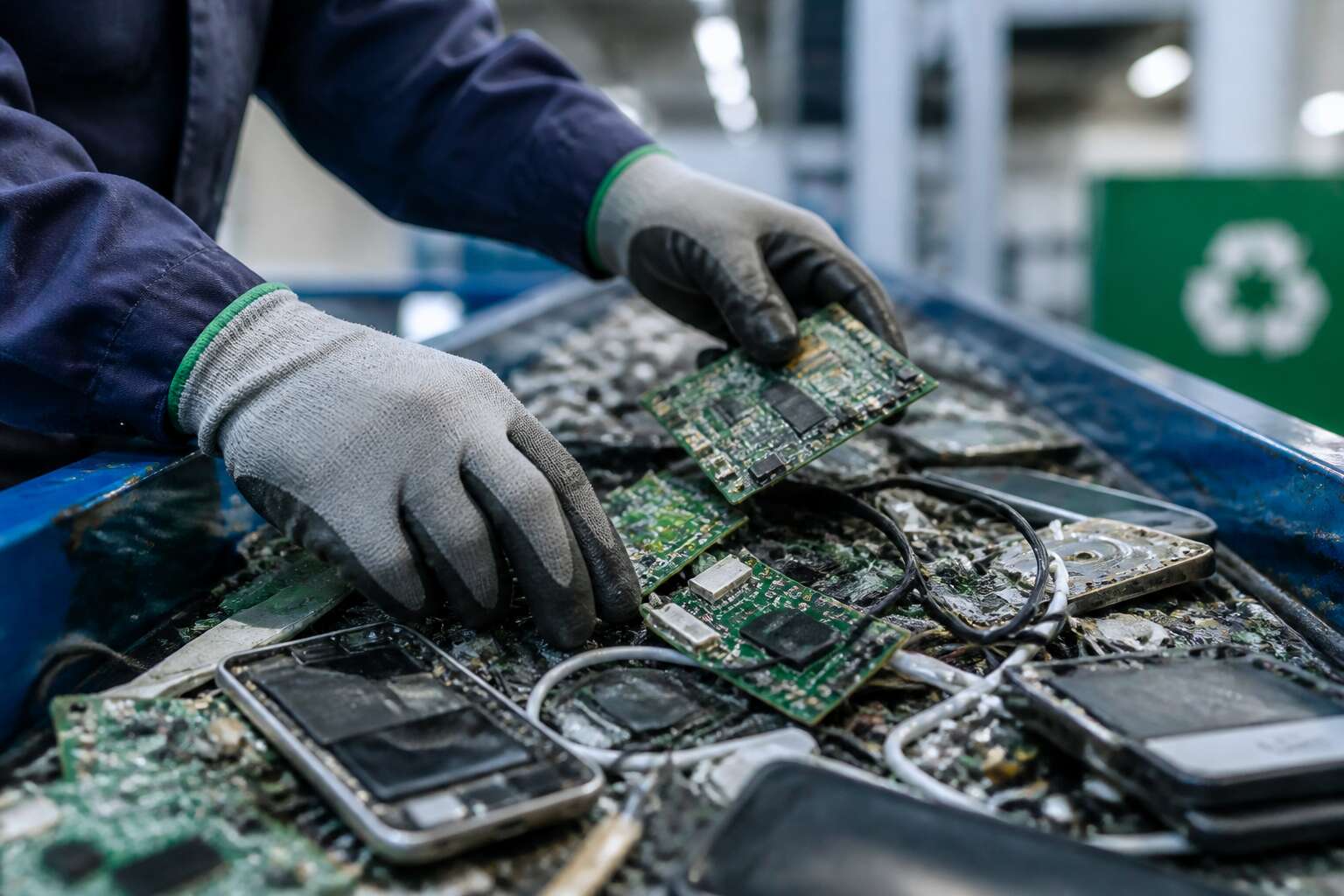
The Growing E-Waste Crisis and Why It Matters
Understanding the Scale of Global Electronic Waste
Global electronic waste hit 62 million tonnes in 2022. That is 62 million small cars, stacked poorly. South Africa alone generates roughly 360,000 tonnes each year. Only a sliver of that, under 12%, makes it to formal recyclers. The rest disappears into landfill or backyard burn sites, where the economics make no one look good.
This matters because electronics are stubborn. They refuse to decompose politely. A single circuit board contains more gold per tonne than many commercially mined ore deposits. For a recycling e waste company, the job is capturing that value before it turns into hazardous dust.
Here is what usually vanishes into the pile:
- Gold and silver from circuit boards
- Copper from motors and wiring
- Rare earth magnets from hard drives
The stuff is not garbage. It is a misplaced supply chain.
Environmental Hazards of Improper Disposal
Every gram of e-waste that misses a formal recycler doesn’t vanish. It sits, leaking tetrabromobisphenol A into groundwater. That is not a poetic tragedy. It is a toxicological process happening under our feet.
When South Africans send old gadgets to landfill, they are not outsourcing sanitation. They are paying for poisoned aquifers, for cadmium climbing into the food chain. The crisis is not abstract. The smell of burning copper on a street corner is a sign of exposure.
- Lead and mercury from screens and batteries
- Brominated flame retardants from casings
- Arsenic from outdated semiconductors
These elements do not wait politely for a recycling e waste company to appear. They migrate. They persist. And they stay dangerous longer than the device ever worked! That is the environmental math most people skip.
Health Risks to Communities and Workers
In South Africa, the fastest growing waste stream is not plastic. It is the discarded circuit board, packed with lead, mercury, and arsenic.
Workers who smash monitors without protection inhale fine particulates that settle deep in lung tissue. Community members near informal dumps face similar risks from airborne dust. A certified recycling e waste company can reduce those exposures through proper ventilation and safe dismantling. Yet the informal sector remains vast.
- Lead exposure impairs cognitive development in children
- Mercury vapors damage kidney and neurological function
- Flame retardants disrupt endocrine systems
These outcomes are not hypothetical. They are measured in clinic visits and chronic illness. The stakes escalate with every phone tossed into a bin, because the body remembers exposure long after the gadget is forgotten.
The Role of Corporate Responsibility in E-Waste Management
The growing volume of obsolete gadgets results from deliberate production cycles. In South Africa, office servers, medical devices, and industrial boards carry planned expiry dates. The response lies upstream, with manufacturers who hold the power to shape what gets built, repaired, or abandoned.
Corporate responsibility in e waste management is not charity. It is design philosophy. When producers take ownership of a device’s end-of-life trajectory, they ease the burden on informal pickers and municipalities. A certified recycling e waste company can handle the recovery safely, but no certified recycling e waste company can compensate for products that fail early.
- Extended producer responsibility shifts accountability away from consumers
- Certified recovery routes keep toxic components inside controlled systems
The role of corporate responsibility in e waste management becomes definitive when volume meets consequence. Every procurement decision we make is either a deposit into a cleaner chain or a liability for someone else to dismantle.
Core Services Offered by Professional E-Waste Recyclers
Secure Data Destruction and Hard Drive Shredding
Deleting a file removes the pointer, not the data. Recoverable fragments stay on drive platters. A professional recycler performs secure data destruction before the shredder touches anything. That means physical hard drive shredding, not software wiping alone. The machine reduces platters to tiny particles. The information becomes unrecoverable.
Reputable operations follow a strict chain of custody. They collect drives, log serial numbers, and provide a certificate of destruction. This protects legal compliance and client confidence. A standard service includes:
- On-site collection and secure transport
- Complete drive disintegration using industrial shredders
- Verification and documentation of the process
Choosing a recycling e waste company that handles destruction in-house reduces your liability. We refuse vague promises of “reformatting.” That method works only for careless competitors, not for a persistent thief. Insist on physical destruction! Your data cannot be recovered.
Asset Recovery and Refurbishment for Reuse
Every discarded device contains both data and residual value. A professional recycling e waste company must separate the two. That starts with a strict triage process before any shredding begins!
Refurbishment for reuse is a careful discipline. Our technicians wipe data, replace worn batteries, and run diagnostic software to validate performance. Devices that pass are resold with warranties, often to schools, community centres, or small businesses. Units too far gone are carefully stripped for salvageable components.
- Functional devices become certified refurbished products.
- Faulty parts feed repair markets and replacement inventories.
- Remaining materials are routed for metals recovery.
This hierarchy creates measurable returns for clients, lowers disposal costs, and keeps working gear in circulation. That is the core service you can expect from any credible recycling e waste company.
Responsible Material Separation and Extraction
Roughly seven percent of the world’s gold is locked inside electronic waste. In South Africa, landfills hold millions of rand in recoverable metals. A professional recycling e waste company treats discarded circuit boards as urban ore. Responsible material separation begins with dismantling, followed by granulation and density sorting. This mechanical process isolates plastics, ferrous metals, and non ferrous metals without contamination.
The extraction stage relies on techniques such as eddy current separation and pyrometallurgy. These methods recover copper, gold, palladium, and aluminium from complex components. Every fraction is weighed and tracked, ensuring transparency for corporate clients.
- High grade boards are sent for precious metal recovery.
- Mixed plastics are shredded for downstream processors.
- Steel and copper are baled for smelters.
This precision prevents hazardous residues from leaking into South African soil and water, while creating a supply chain for secondary raw materials. The result is a service that turns pollution into a measurable resource.
Certified End-of-Life Disposal and Logistics
Every item that leaves your premises carries a responsibility. Certified end-of-life disposal ensures that responsibility doesn’t vanish at the loading dock. A legitimate recycling e waste company provides secure transport, documented chain of custody, and final proof of destruction. Without these, your organisation remains accountable for whatever happens downstream.
Core logistics demand clarity. Scheduled collections, dedicated vehicles, and audited records form the spine of a compliant programme. For industrial clients, this means less guesswork and more control. The service doesn’t stop at pickup. Weighbridge tickets, mass balance reports, and disposal certificates arrive without prompting. That documentation protects you if regulators ask questions. This is where a professional recycling e waste company earns its keep.
Consider what a certified route eliminates: illegal dumping, rogue scrap dealers, and environmental fines. Our ground crews handle the heavy lifting. You receive certainty.
How to Evaluate and Select a Trustworthy E-Waste Partner
Key Certifications to Look For (R2, e-Stewards, ISO 14001)
Certifications are not pieces of paper. They represent a verifiable chain of custody. When vetting a recycling e waste company in South Africa, you should look beyond their marketing claims! The R2 standard demands rigorous environmental, health, and security protocols.
You should also verify e-Stewards accreditation. This certification specifically targets the safe disposal of electronics, ensuring that toxic components do not end up in open landfills. We always ask for these documents directly. A true partner will share them without hesitation.
- Check the validity of the certificate on the official issuer’s database.
- Confirm the scope covers your specific types of electronic assets.
- Verify ISO 14001 compliance for their environmental management systems.
These markers of legitimacy safeguard your business from legal and reputational risk. The recycling e waste company that treats these standards as the baseline is worth your attention.
Transparency in Downstream Processing and Audits
Once a recycling e waste company in South Africa loads your assets onto a truck, the questions should start. Where do those components actually go? Transparency in downstream processing is the difference between a recycler and a middleman who sells to unverified brokers.
A trustworthy partner will show you their downstream vendors by name. They will provide contracts and audit reports without a legal fight. We ask for this paperwork before signing anything.
The best operators also open their facilities for unannounced inspections. A recycling e waste company that documents every ton, every shipment, and every final destination gives you a defensible chain of custody.
Consider what a transparent audit trail includes:
- documented vendor contracts and their certificates
- mass balance reports for inbound and outbound materials
- photographic evidence of the final processing stage
- third party audit findings shared in full
Some vendors resist these requests. That resistance tells you everything you need to know.
Compliance with Local and International Regulations
South African waste regulations evolve quickly, so a partner’s past compliance offers no guarantee for tomorrow. When I vet a recycling e waste company, I ask to see their environmental authorisation and the specific waste streams listed. That document must match the equipment they actually process.
Internationally, the Basel Convention governs transboundary movement. A trustworthy partner should explain their notification procedure without flipping through papers. I also review their annual compliance reports against the tonnage they collect.
Effective evaluation depends on verification:
- Confirm the licence number against the South African Waste Information System
- Request a copy of their most recent environmental inspection findings
- Check whether their insurance covers local and international transit
An operator that cannot connect regulation to daily operations will leave you exposed. I have seen reputable firms fail on these points. The ones that pass share their records freely.
Pricing Models and the True Cost of Recycling
Most businesses only discover the true cost of e-waste recycling when the invoice arrives with hidden line items. Pricing models vary across the industry. Some providers charge per kilogram. Others bill per pallet. A few offer ‘free’ collection that hides downstream expenses. A credible recycling e waste company quotes transparently. They break down transport, labour, data destruction, and material recovery fees.
Pricing structures generally fall into a few categories:
- Per kilogram rates that fluctuate with commodity markets
- Fixed monthly collection fees for recurring pickups
- Itemised quotes that include certificates and compliance documentation
If a price seems impossibly low, it usually is! Illegal operators charge less because they sell hazardous materials to unlicensed smelters or dump components illegally. When I evaluate a recycling e waste company in South Africa, I want a partner who can articulate their pricing structure as clearly as their processes. The cheapest quote usually transfers risk back to your company.
Reputation, Reviews, and Q3 References from Similar Businesses
A glossy website tells you nothing about how a facility actually operates. Evaluating a recycling e waste company requires digging into reputation through independent reviews and direct references. I look for organisations that willingly share client contacts from similar industries.
- Ask for three references from businesses with comparable waste volumes.
- Call those contacts and question them about reliability and transparency.
- Check online reviews on platforms used by South African companies.
References from similar businesses expose a partner’s true behaviour under pressure. A trustworthy provider encourages these conversations, including discussions of past failures. When a company avoids such scrutiny, it signals risk. In the local market, robust due diligence on reputation prevents costly partnerships.
Environmental and Economic Benefits of Partnering with a Dedicated Recycler
Reducing Landfill Waste and Conserving Natural Resources
A certified recycling e waste company converts obsolete electronics into profitable material streams. Every tonne of circuit boards contains copper, gold, and palladium. Responsible recovery keeps these valuable metals out of landfill cells and diminishes the need for destructive mining. The economic result is clear: reclaimed resources lower procurement costs for manufacturers and extend the lifetime of existing equipment.
Dedicated processors also reduce the strain on virgin ore extraction. Less excavation means fewer emissions and cleaner water systems. Advanced sorting technologies, including X-ray fluorescence, deliver purity rates above ninety-five percent. This efficiency creates a steady supply of secondary materials and a measurable return on investment for every partner.
Energy Savings and Lower Carbon Footprint
Recycling one kilogram of copper from a circuit board requires roughly 80% less energy than extracting it from ore. In South Africa, where electricity tariffs climb sharply, that saved electricity is the quiet power of a dedicated recycling e waste company. The energy embedded inside discarded devices becomes a stored resource, recovered before it dissipates.
The carbon ledger works in our favour. Aluminium smelting consumes thousands of kilowatt hours per tonne. Recovering the same metal from a shredded motherboard avoids that whole process, preserving the material’s inherent value without the immense heat of primary production.
- Recycling one tonne of mixed circuit boards prevents around 1.5 tonnes of carbon dioxide from entering the atmosphere.
- Recovered gold requires a fraction of the chemical processing demanded by mined ore.
Each partnership redirects energy away from raw extraction and back into the economy. A capable recycling e waste company converts avoided consumption into measurable operational savings for every stakeholder.
Potential Revenue from Recovered Materials
There is a moment when you look at a pile of dead servers and see only depreciation. A competent recycling e waste company sees a different balance sheet. Inside those circuit boards sit gold, palladium, and copper, materials with real market value. Recovering them turns a liability into a line of revenue. The environmental benefit is straightforward; the economic benefit is equally direct. Client e-waste returns often cover logistics and data destruction costs, with a margin left over. Revenue streams vary by equipment type, but the pattern holds. For example:
- Motherboards and server cards yield precious metals via specialised refining.
- Power supplies and cabling offer clean copper and aluminium bales.
- Batteries contain cobalt and lithium, both in constant demand.
That revenue is no windfall. It is a predictable return from recycling. Transparent recovery rates separate a proper recycling e waste company from the rest.
Enhancing Your Brand’s Green Credentials
Partnering with a dedicated recycling e waste company changes how customers perceive your business. It turns compliance into character. When your annual sustainability report shows measurable recovery figures, that resonates more than any marketing slogan. The economics matter too. A reputable recycler will document material streams, giving you auditable proof of environmental impact. This documentation strengthens tender submissions and investor briefings. It also protects you against greenwashing accusations, which are increasingly costly in South Africa’s regulatory environment. For example, a Johannesburg logistics firm we worked with reduced its carbon reporting gaps by over 30 percent within one year. The benefits accumulate:
– Stronger client retention, because buyers prefer suppliers with credible disposal records.
– Lower reputational risk, since certified processes keep your brand out of questionable downstream operations.
None of this requires heroic effort. It simply demands choosing a recycling e waste company that treats your e waste as a resource, not a burden.
A Step-by-Step Guide to Starting Your E-Waste Recycling Program
Audit Your Current Electronic Waste Inventory
Every kilogram of discarded electronics holds a hidden ledger of materials, costs, and risks. Before you call a recycling e waste company, you must know what sits in your storage rooms, under desks, or in forgotten drawers. This audit is not about counting boxes. It is about mapping every device’s condition, data footprint, and recovery potential.
Start by gathering all e-waste into one open area. Then, identify each item by type, age, and working status. For example:
- Laptops, desktops, and servers
- Monitors, printers, and peripherals
- Batteries, cables, and chargers
Record whether each item contains a hard drive or storage chip. That detail decides whether you need secure data destruction or simple resale. A thorough inventory also reveals hidden assets, like copper in old motors or gold in circuit boards. That knowledge gives you leverage when negotiating with a recycling e waste company in South Africa.
This initial survey feels tedious, but it prevents surprise costs and regulatory fines later. Accurate numbers turn a vague obligation into a manageable plan.
Set Clear Internal Policies for Collection and Labeling
Starting an e-waste program without internal policies leads to confusion. Your recycling e waste company expects clear signals, not guesswork. Define collection points, assign ownership, and label bins by category: working, repairable, end-of-life. This clarity prevents cross-contamination.
Use a simple color system for labeling, blue for data-bearing devices, red for batteries. Staff must know the difference between resale and destruction. One misplaced hard drive can trigger a compliance headache!
- Label every container with the item type and hazard level.
- Set a weekly pickup schedule for each department.
- Document all transfers with a signed handover form.
These policies turn chaos into a replicable routine. Your recycling e waste company will appreciate the order, and you will avoid costly mix-ups.
Choose the Right Recycling Schedule and Data Security Measures
Timing determines whether your e-waste program runs smoothly or stalls. A recycling e waste company in South Africa operates on predictable collection routes. Weekly pickups suit high volume departments. Monthly collections work for storage areas. The gap between collection points is where data breaches occur.
Data security measures require layering. Encrypt devices before transfer. Maintain chain of custody documentation. Verify destruction certificates. Consider this sequence:
- Inventory serial numbers at the point of collection
- Encrypt all data-bearing devices before they leave your premises
- Require a signed manifest from the transporter
- Confirm destruction within 48 hours of pickup
Your recycling e waste company should supply tamper evident bags and locked collection consoles. If they do not, find another partner. The schedule only holds when security protocols are embedded in every step.
Train Your Team on Proper Handling Procedures
The most reliable recycling e waste company in South Africa can only protect your data if your staff know how to handle devices. Training turns policy into consistent practice. Your people must recognise which items hold data, from servers to cellphones. They must know the difference between faulty equipment and obsolete stock. They should understand why encryption happens before the collection truck arrives.
A simple routine builds consistency:
- Tag every device at the moment it leaves the desk
- Place it in the locked console immediately
- Log the handover to the transporter
This sequence prevents gaps in the chain of custody. Without training, even the best recycling e waste company cannot guarantee secure destruction. When your team understands the consequences of mishandling, they help prevent breaches.
Track and Report Your Recycling Impact
Launching your own take-back scheme doesn’t require a massive budget. It requires a clear sequence and a way to measure what leaves your building. Every kilogram handed to a recycling e waste company in South Africa represents materials that avoid landfill and data that stays protected.
The process itself is simple:
- Assign a central coordinator for all e-waste movements.
- Choose a reporting cadence, monthly or quarterly, that matches your operations.
- Capture the weight and device type at each handover.
- Request a certificate of destruction and a downstream audit trail.
Once the numbers start flowing, tracking your recycling impact becomes a matter of comparison. Measure the mass diverted against your previous baseline, or convert it to carbon dioxide equivalent using published factors. A reliable recycling e waste company should provide quarterly reports showing where each stream ended up. These figures feed into your sustainability disclosures and client-facing reports, turning an operational duty into measurable performance.
Continuously Improve Your Sustainability Initiatives
Starting your program is only the beginning. The real value emerges when you treat each month’s data as a prompt for refinement. If collection volumes dip, examine whether the central coordinator has enough authority to keep departments accountable. If staff hesitate, adjust labeling and training materials to match how people actually work.
A good recycling e waste company does more than haul away bins. It provides insights on contamination rates, weight fluctuations, and recovery yields. Use those insights to adjust your internal workflows. Maybe the finance department needs a second collection point. Maybe the logistics team should schedule pickups after quarterly hardware refreshes. That kind of steady calibration keeps your sustainability initiatives moving forward!


0 Comments