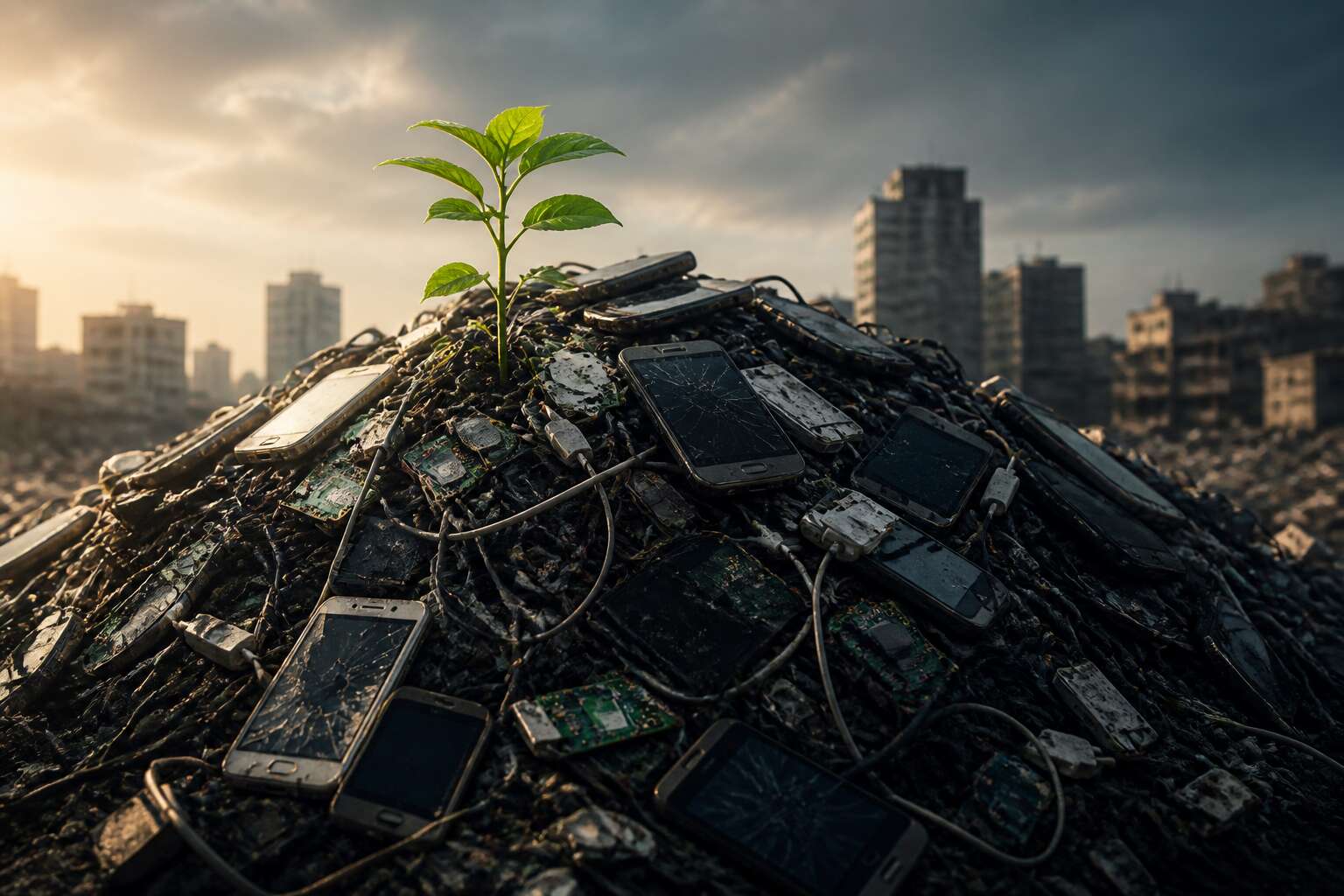
The Rapid Growth of Electronic Waste
Global e-waste generation statistics
Global e-waste reached 62 million tonnes in 2022, with annual growth of roughly 2 million tonnes. That volume would fill more than a million shipping containers, yet only 22 percent is formally recycled. The remainder settles in landfills or informal processing yards, where toxic components seep into soil and groundwater.
The sheer size of this discarded stream is exactly why e waste is a growing concern. Each obsolete phone or laptop holds metals, plastics, and hazardous substances, while consumption outpaces recovery. South Africa alone generates about 360,000 tonnes of e-waste per year, and formal processing capacity cannot keep up!
Several forces feed the acceleration:
- Shorter product lifespans
- Higher device ownership per household
- Fewer affordable repair routes
Each factor compounds the next, turning routine upgrades into rising environmental strain. That accumulation reinforces why e waste is a growing concern for everyone involved.
Short product lifecycles and consumer demand
The annual upgrade has become a cultural habit, a small ceremony where the old device loses its shine. Shorter product lifecycles make this easy, as manufacturers time obsolescence to land right as novelty fades. Devices fail sooner than owners expect, and repair quotes often exceed the cost of a new unit. Disposal becomes the practical choice.
Consumer demand accelerates the churn. Households in South Africa manage more devices per person than a decade ago, and we treat each purchase as a refresh rather than a commitment. The psychological life of a gadget barely outlasts its warranty.
This rhythm is exactly why e waste is a growing concern. Every upgrade sends the previous model out of the home but not out of existence. It joins a stream expanding faster than formal processing can handle. The appetite for new hardware quietly builds an unwanted inventory of the old, and that inventory arrives at landfills or informal yards. Until demand slows, the pile will keep rising.
The role of technological innovation in obsolescence
Technological innovation is framed as progress, yet it shortens the useful life of older hardware. A new Wi-Fi standard can render a perfectly functional router obsolete. An operating system update can leave a phone struggling to run basic apps. The devices lose value through incompatibility rather than failure.
This shift is why e waste is a growing concern. The hardware still works, yet it can no longer participate in the digital ecosystem. In South Africa, new devices arrive with fanfare, and we rarely pause to consider the previous model. It quietly becomes a problem.
Consider how innovation drives this cycle:
- Software updates drop support for older models.
- Replacement components disappear as factories retool.
- New ports and chargers invalidate existing peripherals.
Each step shortens a device’s practical life before the owner is ready to let go. The flow of discarded electronics expands faster than our ability to process it responsibly.
E-waste in developing countries
In South Africa, old devices from richer nations arrive in shipping containers, often labeled as charitable donations. I have watched as mountains of dusty monitors and tangled cables spill onto muddy yards near informal settlements. Their promised second life quickly turns into smoldering fires, as workers extract copper for little money. That raw reality is why e waste is a growing concern in developing countries, long before any bin appears.
The system cannot keep pace.
- Old CRT televisions leak leaded glass into soil
- Phone carcasses arrive without batteries, worthless as scrap
- Plastic shells are burned to access aluminium yokes
Informal reclaimers bear the toxic cost, while municipal budgets lack capacity for safe disposal. The tide of discarded electronics rises faster than safe processing, shifting impossibility onto those with the least protection.
Environmental Consequences of Improper Disposal
Toxic chemicals contaminating soil and water
The permanence of discarded electronics is a fiction. When a circuit board is buried in a landfill, the surrounding soil absorbs its chemical inheritance. Lead, cadmium, and mercury slowly leach from cracked casings, moving through earth and groundwater.
This toxic plume does not remain confined to the dumping site. Rainfall accelerates the transport of these heavy metals, pushing them into aquifers that supply residential wells and agricultural irrigation. The result is a silent contamination of water sources used for drinking and food production.
The primary hazards from this process include:
– Lead causing neurological damage, particularly in children.
– Cadmium accumulating in the kidneys and liver.
– Mercury converting to methylmercury, which concentrates up the food chain.
The Western Cape has documented soil contamination near informal e-waste processing points, a sample of a wider crisis. Water processing plants can filter many pollutants, but they are not designed to remove industrial-grade solvents and flame retardants. Households dependent on boreholes are left to draw water that carries a hidden toxic burden. This contamination footprint is one clear reason why e waste is a growing concern, transforming a convenience of modern life into a public health liability that outlasts the devices themselves.
Air pollution from open burning of electronics
Open burning of electronics is the dirtiest way to reclaim scrap metal. A blowtorch applied to a circuit board releases a plume of particulate matter, brominated flame retardants, and dioxins. In South Africa, informal recyclers use this method because it is fast and cheap. The smoke does not stay in the yard!
- Dioxins and furans, which are carcinogenic and persist in the environment.
- Polycyclic aromatic hydrocarbons, linked to respiratory disease.
- Fine particulates that penetrate deep into lung tissue.
That airborne plume drifts into residential areas and settles on surfaces. The health effects are immediate and cumulative. This is why e waste is a growing concern, because the damage is inhaled before it is ever measured.
The impact of rare earth metal mining
The appetite for minerals inside discarded devices extends far beyond the landfill. Rare earth elements, prized for their magnetic and conductive properties, are extracted from open pits that scar entire landscapes. Soil is stripped, water tables drained, and radioactive byproducts often accompany refining. This is the unseen cost of every sleek component.
When a device is tossed aside instead of recycled, the pressure to mine fresh ore intensifies. That is why e waste is a growing concern. Each abandoned phone or unplugged monitor signals demand for another tonne of earth to be torn apart.
The consequences of this extraction extend well beyond the mine:
- Groundwater contamination from leached metals and processing chemicals.
- Topsoil loss that leaves land barren for generations.
- Energy intensive refining that releases greenhouse gases.
The impact does not stop at the boundary. Tailings ponds and acid drainage travel downstream, altering ecosystems and livelihoods.
Greenhouse gas emissions from production and disposal
The most polluting part of a device is often its birth, not its burial. The journey of a single microprocessor through cleanrooms and furnaces may discharge the atmospheric equivalent of driving a standard passenger car for a month. That initial expense is fixed; the variable is how the device meets its end.
When improperly discarded, the frail body of electronics continues emitting. Mercury switches smoulder quietly; an oxidised capacitor vents particulates; and the plastic facades in a landfill slowly release methane. This is why e waste is a growing concern. The disposal, properly managed, could neutralise this second charge, but the informal dismantling scene lets it slip into the air.
- Circuit boards with frosty shields release hydrofluorocarbons during heat treatment.
- Ventilators imply compressor fans ether that then displace atmosphere storage cells.
- the dismantled cooling systems speak silently of potent refrigerant gas, three thousand times heavier than carbon.
This tangled ledger of invisible output makes the horror less about the mine and more about a carbon account. That decaying assembly still counts. And the count climbs with each abandoned device, regardless of its ground state, for those emissions are not in the vehicle but in the merely unmade.
Devastation of local ecosystems
In South Africa, discarded electronics often end up in wetlands and grasslands that sustain local communities. The ecological shock is measured in dying pollinators, stunted vegetation, and streams that carry heavy metal residues into the wider catchment.
The devastation of local ecosystems is quiet, but the inventory is not:
- Lead from old circuit boards accumulates in floodplain soils.
- Mercury from switches enters the food web through aquatic insects.
- Cadmium and chromium stress root systems, collapsing natural vegetation.
Frogs disappear. Seedlings fail. This is why e waste is a growing concern. Each discarded board reorders the natural balance, leaving farms and reserves to carry a burden no policy has yet addressed.
Health Risks to Humans and Communities
Exposure to lead and mercury in informal recycling
Every year, thousands of informal waste pickers in South Africa handle broken televisions and computers without protective gear. They smash cathode ray tubes to reach copper coils, releasing fine dust into the air. That dust contains lead and mercury, two neurotoxins that accumulate in the human body. This is why e waste is a growing concern for communities that depend on recycling for income.
Exposure occurs through multiple routes. Workers breathe in toxic fumes when melting circuit boards. They touch contaminated components, then eat without washing. Mercury vapor moves easily across space, affecting families in neighboring homes. Lead dust settles on floors and clothes, where children crawl and play. I have seen workers with bare hands pulling apart old monitors!
Health consequences appear slowly. Adults experience memory loss, high blood pressure, and kidney dysfunction. Children suffer more severely, with irreversible brain damage. Common symptoms include:
- Chronic headaches and fatigue
- Muscle weakness and tremors
- Behavioral changes and developmental delays
Effects on reproductive and neurological health
The reproductive toll surfaces quietly within communities. Men exposed to heavy metals suffer diminished sperm quality, while pregnant women face elevated risks of miscarriage and premature birth. The chemicals cross the placental barrier, reaching the fetal brain.
Documented harms include:
- Higher stillbirth rates near processing sites
- Reduced fertility among male workers
- Neonatal complications from maternal toxin exposure
Neurological damage compounds across generations. Children born in South African settlements near e waste sites display lower cognitive function, attention deficits, and learning difficulties that persist into adulthood. Mothers transfer accumulated toxins through breast milk, extending the chain.
Why e waste is a growing concern becomes clear when we examine the generational pattern. Most families cannot afford medical testing, so symptoms remain undiagnosed until disability manifests. Clinics in affected settlements report rising cases of neurodevelopmental disorders, yet no formal health surveillance exists. We cannot ignore the accumulating evidence!
Occupational hazards for e-waste workers
The labour of dismantling electronics exacts a direct toll. Workers in South African e waste yards face occupational hazards for e-waste workers that are immediate and lasting. Shattered casings cut unprotected hands, copper wire resists pliers until tendons ache, and plastic dust hangs thick in unventilated rooms. Each breath carries brominated flame retardants, cadmium, and beryllium. Many toil without gloves, respirators, or extraction fans.
The daily injuries form a grim inventory:
- lacerations and punctures from broken glass and metal shards
- burns from soldering irons and heated circuit boards
- chronic bronchitis and occupational asthma from fine particulate inhalation
- kidney and liver damage from industrial solvents used to strip components
Why e waste is a growing concern lies partly in this human cost. These workers are often young, often undocumented, and rarely registered for any compensation scheme. Their ailments surface years later, by which time the original device has been recycled twice over.
Contaminated food and water sources
The contamination does not stop at the soil. It moves into the food chain. Crops planted near informal e-waste sites absorb cadmium and chromium through their roots. Livestock graze on contaminated pasture and drink from polluted streams. Communities that rely on these food sources ingest toxins with every meal. Water carries the problem further. Heavy metals leach into groundwater and travel beyond the original dump site. Boreholes that once provided clean drinking water now test positive for lead and arsenic. Consider the typical exposure pathway:
- Crops take up heavy metals from contaminated soil
- Fish accumulate mercury in rivers and dams
- Dairy products carry dioxins from grazing livestock
This is why e waste is a growing concern for ordinary families, not just recycling workers. The person eating vegetables from a home garden may face the same health risks as the person smashing circuit boards.
Economic Pressures and Lost Resources
The value of precious metals in e-waste
Each year, discarded electronics carry away billions of rand in gold, silver, palladium, and copper. Those materials hold real monetary value even after disposal. In South Africa, where mining costs climb ever higher, the economic pressure to recover these resources is undeniable. This is precisely why e waste is a growing concern for both business and government.
Recovering metals from circuit boards does more than help the environment. It is a financial imperative! A single tonne of mobile phones can yield more gold than a tonne of gold ore. Consider what is lost:
- Gold for connectors and wiring.
- Palladium in capacitors.
- Silver in solder.
- Copper in cables.
Every device ending in a landfill without deconstruction represents direct economic loss. The hidden value in e waste is enormous, and failing to reclaim it deepens pressure on economies strained by volatile commodity prices.
Cost of recycling versus landfilling
Landfill tariffs in South Africa are climbing, but the true cost of dumping e waste extends past the gate fee. A discarded circuit board holds copper, palladium, and gold that become permanently unrecoverable. Recycling requires capital for shredders, sorters, and smelters, yet it returns value from recovered metals and sidesteps future clean up costs. The economic balance is shifting, and this is why e waste is a growing concern for CFOs and municipal treasurers. The real expense of landfilling includes:
- Transport and tipping fees
- Leachate treatment and monitoring
- Lost resale value of materials
- Long term liability for contaminated soil
Recycling converts several of those costs into revenue, but the upfront investment is hard to swallow when budgets are tight. I have watched companies choose the cheaper landfill invoice today, only to face steeper losses tomorrow. That pattern explains why e waste is a growing concern for anyone tracking the balance sheet.
The economic burden on municipalities
Municipalities carry a burden households rarely see. When e waste enters the landfill, the financial damage spreads across the local economy. Property values near landfill sites decline. Rates collections suffer. The cleanup bill eventually lands in the budget of the same council that accepted the waste.
Consider the standard sequence:
- The council pays for the landfill space.
- The recoverable copper and palladium lose all value.
- Leachate monitoring costs rise year after year.
- The ratepayer absorbs every cent.
That sequence is why e waste is a growing concern for municipal treasurers. The lost resources are not merely metals. They include the chance to build formal recycling jobs, reduce pressure on the water table, and extend landfill lifespans. Every kilogram of e waste buried removes economic potential from the municipal ledger.
Illegal exportation and black market trade
Illegal exportation turns a national crisis into a quiet transaction. I have seen containers leave Durban harbour labelled as scrap, packed instead with circuit boards and dead hard drives. The black market trade thrives on our hesitation. It moves through informal networks, avoiding customs checks, and sells stolen resources to brokers who pay cash and ask no questions. This is why e waste is a growing concern. The economic pressures do not disappear when the truck rolls away. They simply shift. Lost resources, from copper to gold, fund opaque operations instead of local recovery facilities.
Consider what vanishes each month:
- Precious metals stripped from memory chips and connectors
- Lithium batteries resold to unlicensed refurbishers
- Motherboards shredded for export without safety measures
Every transaction leaves South Africa poorer, and the burden returns through higher costs for legitimate recyclers.
Opportunities for a circular economy
Every discarded circuit board holds recoverable material. The economic pressures compound when recovery infrastructure remains underdeveloped, and that is precisely why e waste is a growing concern. We lose material value and the chance to build local resilience.
A circular economy changes the equation. Instead of exporting shredded boards, we recover cobalt, palladium, and aluminium through formal channels. The opportunities are concrete:
– Refurbishing whole devices for the secondary market
– Recovering rare earth magnets from hard drives
– Feeding recycled plastics into local manufacturing
These steps create jobs and lower the cost of raw materials. The resources we bury today are the ones we will import tomorrow at a premium. Seizing them now keeps value in the local economy.
Job creation in formal recycling sectors
Every ton of circuit boards we bury is a payroll we never funded. The formal recycling sector could employ thousands of South Africans in sorting, refurbishing, and material recovery. Instead, we ship the problem overseas and call it progress.
- Refurbishment hubs for second hand laptops
- Magnet recovery from old hard drives
- Plastic pellet suppliers for local factories
That is why e waste is a growing concern. We are choosing imported raw materials over local ingenuity. The jobs are waiting, but the infrastructure barely exists.
Legislative Gaps and the Need for Global Action
Inconsistent e-waste regulations across countries
Inconsistent e-waste regulations across countries create a labyrinth of loopholes that savvy traders exploit with alarming ease. One nation’s hazardous waste is another’s lucrative commodity, and this regulatory patchwork makes a mockery of international efforts. The Basel Convention tries to govern transboundary movements, but its teeth are dull when wealthy nations shoulder the burden of proof. As a result, containers labeled as “second hand goods” routinely slip through customs, carrying loads that any trained inspector would recognize as hazardous.
South Africa finds itself in a particularly awkward position. Our own e-waste legislation is comparatively progressive, but it struggles to compete with the sheer volume of illegal imports. Meanwhile, the European Union has implemented strict producer responsibility schemes, yet their enforcement rarely extends beyond their own borders. This creates a bizarre global dynamic where we have stringent rules for the rich, lax rules for the poor, and virtually no mechanism to close the gap. The result is that the regions least equipped to handle hazardous materials become the dumping grounds for everyone else’s obsolete gadgets.
This legislative dissonance directly fuels why e waste is a growing concern. When a country like China bans the import of plastic scrap, the material simply redirects to nations with weaker oversight. The patchwork nature of global e-waste law also complicates legitimate businesses. A compliant South African recycler competes against illegal operators who face minimal risk of prosecution. Common regulatory loopholes include:
– Differing definitions of what constitutes hazardous e-waste
– Inconsistent labeling and documentation requirements
– Weak penalties that function as a minor cost of doing business
– A near total absence of inspection capacity in developing ports
The absence of a binding global treaty on e-waste management means every nation effectively writes its own rulebook. This fragmentation not only undermines environmental protection but also distorts legitimate markets. Why invest in proper recycling infrastructure when cheaper, illegal alternatives exist? This question sits at the heart of legislative gaps and the need for global action, representing a structural failure in how we govern the digital age. A unified approach remains a distant dream, and our collective reluctance to embrace one is precisely why e waste is a growing concern in every corner of the planet.
The Basel Convention and transboundary movement
The Basel Convention remains the closest thing we have to a global framework for controlling hazardous waste movements. Yet its mechanisms rely on prior informed consent, a process that crumbles when exporting nations lack the will or resources to verify what actually leaves their ports. For a country like South Africa, this means the convention’s protections often feel theoretical rather than practical.
Transboundary movement of e-waste persists because enforcement depends on national governments acting in good faith. The gap between policy and practice grows wider each year, and the consequences land disproportionately on developing nations. This structural weakness is precisely why e waste is a growing concern. Until the Basel Convention gains genuine teeth, including mandatory audits and binding penalties for non-compliance, the legislative vacuum will continue to attract bad actors.
Extended Producer Responsibility (EPR) policies
Extended Producer Responsibility (EPR) policies hold a simple promise: make the manufacturer pay for the afterlife of their products. South Africa has EPR regulations on paper, but enforcement remains selective. Producers file reports, pay levies, and move on, while the recycling figures fail to match their paperwork.
The legislative gaps run deep. There are no standardised metrics, so data can be stretched. There are no penalties that hurt, so non-compliance becomes a cost of doing business. And provincial rules vary, meaning a producer in Gauteng answers to a different standard than one in the Western Cape.
- No mandatory take-back schemes for most electronics
- No binding recovery or recycling targets
- No public registry of compliant producers
This distance between law and practice is exactly why e waste is a growing concern.
The need for consumer awareness and education
Most consumers never see the fine print of electronics legislation. We hand over an old phone at a collection point and assume the problem is solved. In reality, the chain stops at the border. A country can pass strict laws, but if its neighbours refuse to do the same, e waste migrates to weaker rules. That is why e waste is a growing concern: no nation can regulate a global market alone. The gaps between jurisdictions become loopholes.
Consumers remain the least informed link. Few know what happens after the bin is emptied. This ignorance is not accidental! Manufacturers have little incentive to publicise the true cost of disposal. Consider what the average person is never told:
- Whether a device is recyclable or exportable
- Which components contain hazardous material
- Why repair often costs more than replacement
Without honest information, the cycle continues.

0 Comments