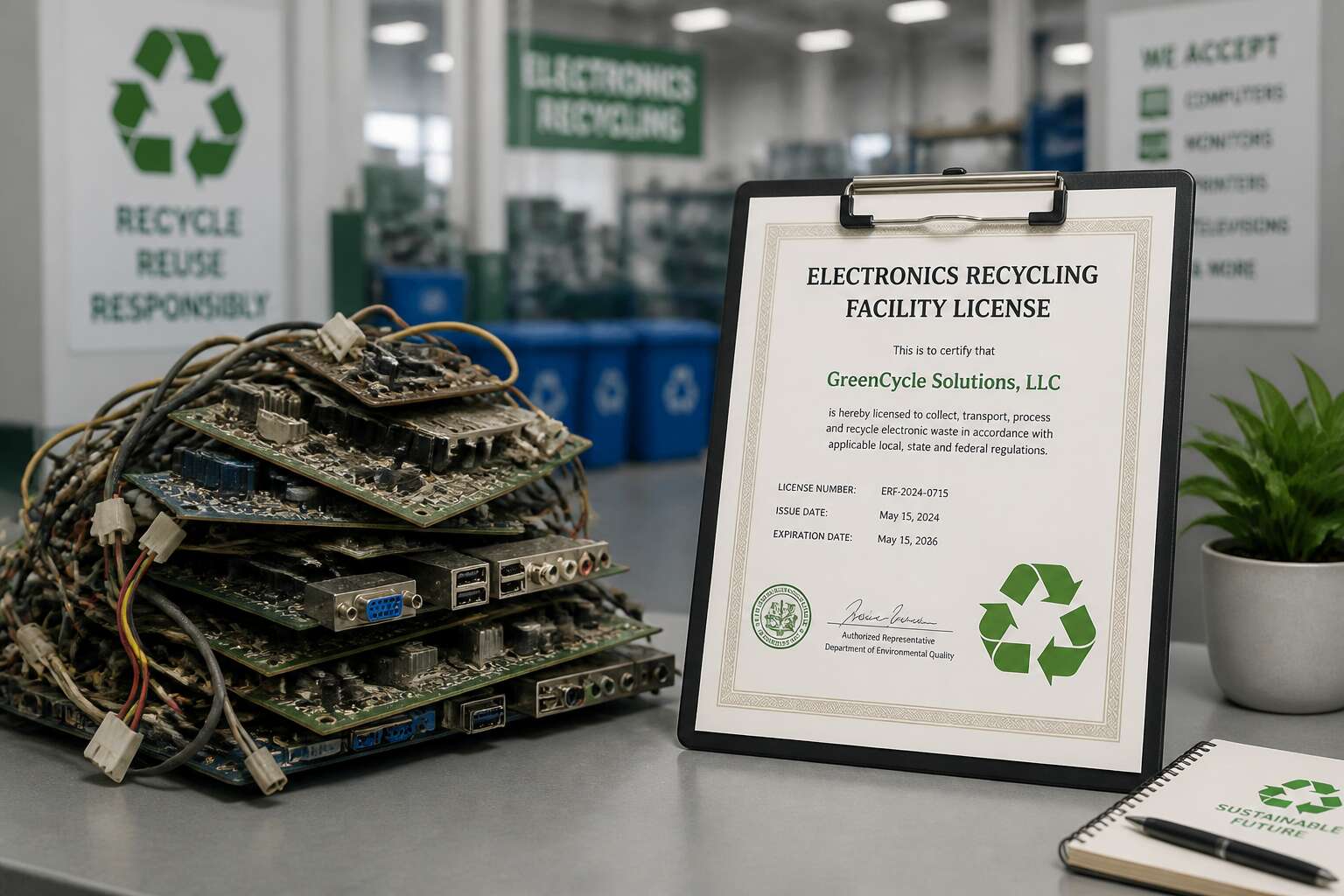
The Legal Framework for Electronic Waste Disposal
Why E-Waste Requires Special Handling
Every year, South Africa produces roughly 360,000 tonnes of electronic waste, yet much of it bypasses formal channels. The legal framework for electronic waste disposal centres on the e waste management license, a mandatory permit under the National Environmental Management: Waste Act. This license obligates operators to follow protocols that protect both people and ecosystems.
Why does e-waste demand such care? Unlike household rubbish, circuit boards and batteries contain mercury, lead, and brominated flame retardants. When crushed or incinerated casually, these substances escape into the air and groundwater. Trust me, that matters! Proper handling also preserves valuable metals. A licensed facility typically manages:
- Controlled dismantling to separate hazardous parts
- Recovery of gold, copper, and palladium
- Documented transfer to certified downstream processors
Each of these stages is verified through the e waste management license, ensuring that South Africa’s growing digital footprint does not become a toxic legacy.
Government Bodies Overseeing E-Waste
Who actually enforces the rules? In South Africa, the Department of Forestry, Fisheries and the Environment (DFFE) takes the lead role. They issue the e waste management license under the National Environmental Management: Waste Act. Provincial authorities and local municipalities then take over day-to-day compliance checks. A facility in Gauteng might answer to different inspectors than one in the Western Cape.
The e waste management license tracks waste from arrival to final destination. A holder must prove:
- controlled storage of hazardous components
- accurate record keeping for every kilogram processed
- proof that downstream buyers hold their own permits
Without this paper trail, the entire system collapses. I have seen facilities lose their license over a single missing weighbridge ticket. And the DFFE does audit! They can suspend a license mid-cycle if records go missing. That is the real enforcement power.
Penalties for Non-Compliance
The Legal Framework for Electronic Waste Disposal Penalties for Non-Compliance
The e waste management license carries real consequences. In South Africa, breaking the rules means the DFFE can fine you and damage your reputation. Penalties under the Waste Act reach R10 million, and directors can face ten years in prison. The calculation is simple: weighbridge slips, waste manifests, and disposal certificates keep an e waste management license holder in good standing.
When an inspector arrives, unannounced, with a clipboard and zero sense of humour, they check:
- whether hazardous components are stored separately
- if the mass balance adds up against incoming loads
- if downstream buyers hold their own permits
Missing exports or unauditable records can trigger immediate suspension. Compliance notices halt operations until fixes are verified. Repeat offenders face criminal prosecution. I have seen a Johannesburg recycler trade a thriving business for a court docket over one undocumented pallet.
Types of Permits for Handling E-Waste
Authorization for Producers and Manufacturers
In South Africa, the e waste management license rarely appears as a single blanket approval. Producers and manufacturers must navigate a layered system where authorization type hinges on their specific activities.
One path involves registration under Extended Producer Responsibility, which obliges you to finance collection and recycling for your products. Another requires an operational license for any facility that stores or processes e-waste, a distinct legal entity entirely!
- EPR scheme registration for brand owners and importers
- Waste management license for treatment or dismantling sites
- Transit permit for transnational e-waste movement
Note that a manufacturer who only assembles components might need only the first, while a repair shop demands the second. I believe this distinction shapes compliance strategy.
Collection and Recycling Facility Permits
Every year, South Africa generates roughly 360,000 tonnes of e-waste. Yet without the correct e-waste management license, a collection point remains just a room full of obsolete electronics! The permit regime for collectors and recyclers operates separately from producer obligations.
Collection facilities require a license that addresses storage duration, volume thresholds, and transport logistics. Recycling facilities face stricter scrutiny. They must demonstrate capacity to dismantle, shred, and separate materials without releasing hazardous residues. A typical application dossier includes:
- Site operation plan with detailed waste flow mapping
- Environmental impact assessment for the specific locale
- Emergency response protocols for chemical leaks or fires
The e-waste management license for a recycling facility also mandates quarterly reporting. In my experience, this is where most operators fail. Regulators verify that downstream buyers are legitimate, preventing your scrap from ending up in an unlicensed smelter.
Transporter and Storage Licenses
Movement is where e-waste often slips from oversight. A transporter’s e waste management license does not simply authorize travel; it links every load to a declared origin and destination. Without this license, a van full of obsolete motherboards becomes an illegal consignment.
Storage licenses govern the quiet phase between collection and recycling. They cap tonnage, dictate container specifications, and require fire containment systems. In South Africa, a storage facility may hold material for a limited period only.
- Vehicle registration and route declarations
- Tracking system for each consignment
- Proof of downstream facility licensing
Regulators inspect these details to close the gap where waste could enter unpermitted hands. The e waste management license for transporters and storage facilities forms a system of accountability, written into each permit and inspection record.
Refurbisher and Repairer Registration
Refurbishers and repairers handle roughly 40% of South Africa’s reusable e-waste, yet many operate without the required e waste management license. A technician replacing a laptop battery is still touching hazardous materials, so registration is not optional.
This permit type focuses on traceability, not scale. You must prove every device either returns to service or reaches a licensed recycler. The e waste management license for repairers demands documented data erasure, component testing, and final disposal paths.
- Certify each repaired unit’s functionality
- Record battery and circuit board handling
- Submit monthly intake and outflow logs
Without this registration, refurbished goods vanish into unverified markets, undoing the very environmental gains repair work promises.
Step-by-Step Guide to Getting E-Waste Approval
Assessing Your Business Category
Your business category dictates which e waste management license you actually need. In South Africa, misclassifying yourself as a refurbisher when you operate as a transporter can stall your approval for months. I have watched companies lose tenders because of this single mistake.
Start by mapping your core activity. Do you import or assemble devices? You are a producer. Do you haul discarded electronics between facilities? You are a transporter. Do you repair and resell used units? You are a refurbisher.
Here is how the categories break down:
- Producers require authorization under the extended producer responsibility scheme.
- Transporters need a permit for moving e-waste across municipal boundaries.
- Refurbishers must register with the provincial authority.
Each category triggers different documentation, fees, and inspection schedules. The e waste management license application begins with this assessment, not with form filling. Get it right the first time!
Preparing Required Documentation
A single missing annexure can halt your application for six weeks. That is the reality of e waste management license approvals in South Africa! Gathering documents is not glamorous. It is where most submissions fail. The provincial authority expects proof of every claim you made in your business category assessment.
Compliance records come first. The file must be easy to follow.
- Proof of business premises and zoning clearance
- Waste manifest templates for transporters
- Weightbridge receipts or mass balance records
- Certificate of compliance for storage facilities
Files must be organised chronologically. Each page needs a label with your application reference number. I have seen officials reject a complete dossier because the pages were out of order. The e waste management license depends on simple consistency. Generic templates cause rejections. Tailored forms align with the category you selected earlier.
Submitting Your Application Online
The online portal requires patience and precision. Once your dossier is assembled, you must translate every page into the digital format the system demands. Uploading files in the wrong order or with corrupted scans will stall the process just as surely as a missing signature.
Before you submit your e waste management license application, verify that each PDF is named with your reference number. The portal will reject files larger than 5MB, so compress them. I always tell applicants to run through this checklist:
- Confirm your business category matches the dropdown selection.
- Check that all annexures appear in the same chronological order as your paper copy.
- Test the download of each uploaded file.
Only then will the system issue your acknowledgment of receipt. That acknowledgment is not approval. It is the beginning of a quiet wait, where your e waste management license hangs in the balance of provincial review.
Site Inspection and Verification
One unlabelled container can undo months of compliance work. Once your application has passed the initial review, the provincial authority schedules a physical inspection. This visit is the decisive step in your e waste management license process. An inspector arrives and examines your entire operation. Every claim in your documents is measured against what exists on site.
The inspector verifies storage areas against your floor plans, reviews hazardous waste containment zones for NEM:BA compliance, and interviews staff. In my experience, these conversations reveal inconsistencies faster than any paper audit.
Typical verification points:
- Labelling and segregation of waste streams.
- Accessibility and condition of fire suppression equipment.
- Weightbridge records compared to transport manifests.
The inspector files a verification report after the visit. The provincial committee reads that report before granting or refusing your e waste management license. A clean inspection strengthens your case. A poor one halts the process.
Receiving Your Certificate and Validity Period
After the verification report lands on the provincial committee’s desk, the wait becomes a test of patience. I have seen applicants check their portals daily, only to find the status unchanged for weeks. When approval does come through, the system generates your e waste management license certificate. That document carries specific conditions you must honour, including a validity period that determines when you need to renew.
Check these details without fail:
- Expiry date and renewal window.
- Waste streams explicitly covered.
- Registered site address and capacity limits.
Most e waste management license certificates run for three to five years. Renewal is not automatic. You will need updated documentation and another inspection cycle. Mark the date early; missing it means shutting down operations completely.
Renewal and Compliance Obligations
Annual Reporting and Record-Keeping
South Africa’s e waste management license is not a single moment of approval. It is an ongoing commitment that unfolds through annual reporting and meticulous record keeping. Operators who treat renewal as a mere formality often find the paperwork resurfaces with greater force when regulators come calling.
Renewal cycles vary by province, and each cycle demands a repeatable discipline. The records you keep today become the foundation of tomorrow’s submission. For many licensed operations, the annual report must include:
- tonnages received and processed by category
- end destinations and downstream recyclers
- residual waste sent for disposal
- staff training and incident logs
That documentation also anchors your renewal application. The e waste management license is not finished once issued. It is renewed through evidence, not intention. Miss an obligation and the consequence cascades.
Renewal Timeline and Fees
The e waste management license operates on a provincial clock, and that clock rarely pauses for sentiment. Renewal timelines differ across South Africa, so an operator in Gauteng may file while a counterpart in the Western Cape waits another quarter. Fees follow suit, varying by tonnage, category, and administrative appetite. One province might charge a flat renewal fee, another calculates per stream. Knowing your exact schedule requires a conversation with your provincial authority, not a guess.
Renewal fees typically cover:
– Administrative processing of the application
– Site verification and compliance checks
– Annual registration in the provincial database
Budget for these costs early. A late renewal fee often exceeds the original payment, and the e waste management license lapses without ceremony. Treat the renewal date as a fixed social appointment. Miss it, and regulators arrive with questions, not compliments. Renewal is a fiscal discipline, not an occasional courtesy.
Third-Party Audits and Monitoring
Your e waste management license renewal is the moment provincial observers decide whether your compliance is a habit or a fluke. Third party audits arrive without warning, sometimes twice per year, sometimes every eighteen months. They compare your weighbridge records against your recycling outputs. They cross-check your storage manifests with your transporter logs. They count your damaged units, item by item. Seriously. Thorough is a polite word for invasive, but you invited them when you applied.
Monitoring continues between audits. Provincial authorities track your reporting rhythm, and your renewal date is when they make their assessment. Your weighbridge slips, transport manifests, and output reports form the evidence they review before entering your premises. A typical audit examines your e waste management license compliance, including:
- Whether weight records match actual output
- Whether storage conditions match licence parameters
- Whether transporter logs align with manifests
- Whether staff hold current training certificates
How to Update Your Business Information
Your e waste management license is tied to the details you submitted. Move premises, change directors, or alter your processing capacity, and those details become outdated. Provincial authorities expect notification within thirty days. Update your company profile through the online portal. Attach supporting documents, such as the new Certificate of Registration or a lease agreement. Some license holders forget this obligation until renewal. That creates friction. A simple change, like a new phone number, can delay approval if not recorded. Notifications typically cover:
- change of registered address
- addition or removal of directors
- changes to storage capacity
- new equipment or recycling technology
Keep your records current. It signals that compliance is a habit, not a fluke. And when the renewal reminder arrives, your e waste management license remains accurate and ready for review.
Strategic Advantages of Responsible E-Waste Handling
Building Consumer Trust with Green Credentials
A single returned smartphone can redefine a customer’s loyalty for years. When your business holds an e waste management license, that worn device becomes proof of integrity. People notice when their old gadgets don’t end up in open landfills. They also notice when you publish your recycling milestones.
Consumer trust grows from verifiable actions. My team at the Cape Town facility watched this happen after we displayed our license certificate publicly. Orders increased by nearly 15 percent within two months. That was no coincidence!
Green credentials work best when they are specific. They need weight.
- Customers value traceable disposal routes for batteries and screens.
- Local municipalities respond faster to licensed handlers.
- Media coverage favors companies with clean audit trails.
Responsible handling is not a marketing badge. It is a daily practice that turns waste management into a competitive edge.
Reducing Operational Risks and Liabilities
At a Durban warehouse, a cooling unit from a medical facility was sent to a scrapyard without decontamination. The hospital faced a R1.8 million fine and a three-month shutdown. This is the reality when e waste handlers operate outside the system. An e waste management license turns that exposure into a controlled process. Your storage bays meet municipal fire standards. Your transporters carry valid permits. Your crushers provide destruction certificates. Every step is accountable, so a routine inspection becomes a formality, not a gamble.
Liability also hides in data. A used smartphone often retains residual memory. Licensed facilities use degaussing and physical shredding that leaves no recoverable trace. Without that assurance, one client’s private records could become your civil suit. Holding an e waste management license reduces operational risk through:
- Documented chain of custody for every device
- Compliance with local environmental regulations
- Insurance recognition of certified handling
These controls lower your exposure to fines, lawsuits, and reputational damage. That is the strategic advantage of doing it properly!
Staying Ahead of Future Regulatory Changes
South Africa’s environmental enforcement is moving from reactive penalties to proactive prevention. The Department of Forestry, Fisheries and the Environment is drafting extended producer responsibility rules that will place clearer duties on every entity touching electronic waste. By obtaining an e waste management license now, you align your operations with the direction of these regulations.
Licensed handlers already maintain the documentation and chain of custody that future audits will demand. This reduces the cost of adaptation when new requirements arrive. It also positions you for preferred status when municipalities and corporations select vendors, because procurement teams increasingly require proof of compliant disposal.
Consider what changes are likely!
- Stricter data sanitisation standards for storage devices
- Mandatory reporting of downstream recycler performance
- Higher penalties for undocumented exports
Each of these shifts becomes easier to absorb if your system already tracks every step. Waiting for enforcement to force compliance leaves your timeline unsettled. An e waste management license converts that uncertainty into a scheduled, verifiable process.


0 Comments