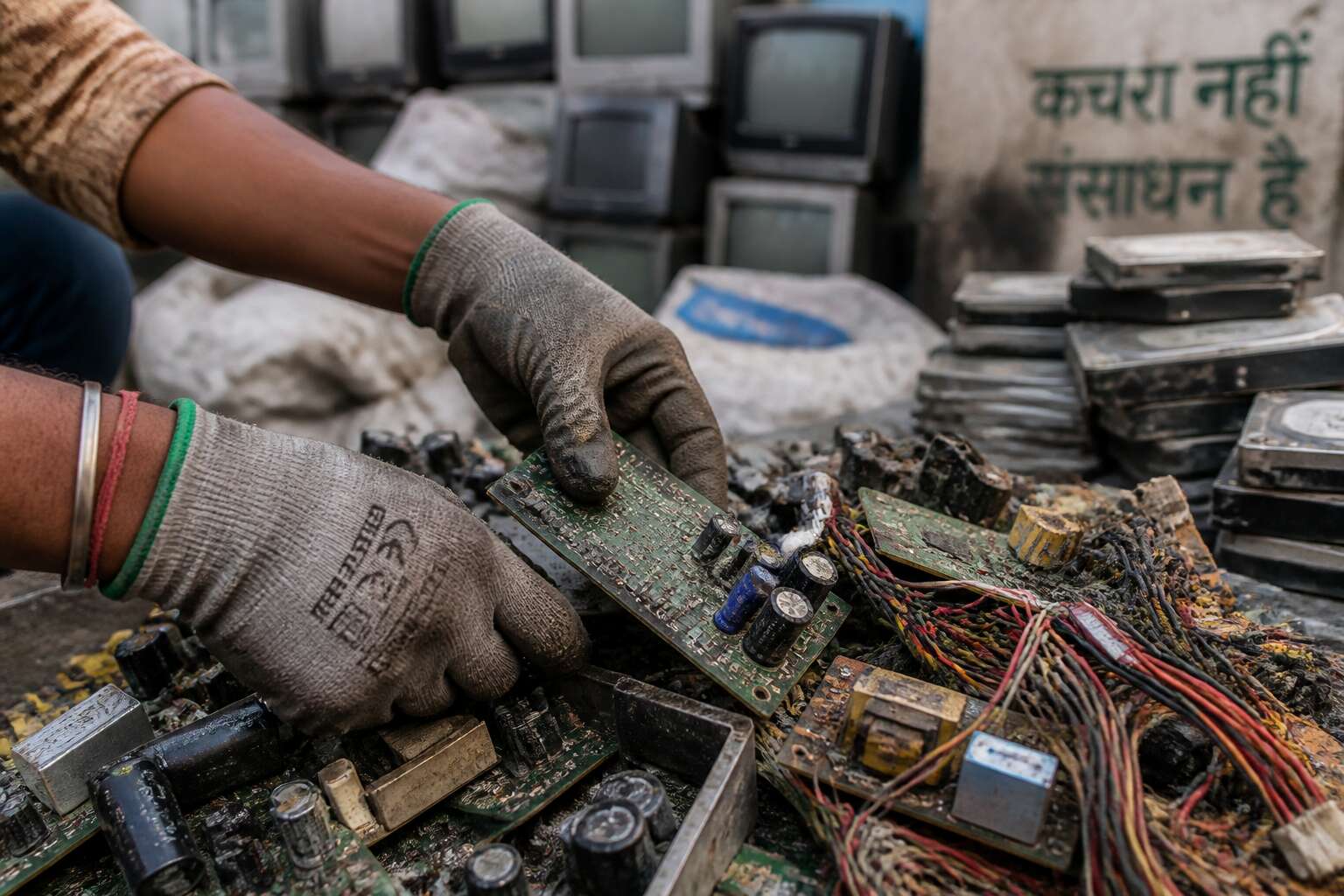
Current E-Waste Scenario in India
Statistics and Growth Trends
India’s e-waste stream has become a paradox: rich in recoverable minerals, yet hazardous when mishandled. Official figures show India generated 1.6 million tonnes of e-waste in 2021-22, yet formal recyclers processed barely 30%. The growth rate sits near 30% annually, outstripping most global markets, with no sign of flattening as digital adoption deepens across smaller cities.
The waste mix itself is transforming. Small IT gear and consumer electronics lead by volume, but solar panels and lithium-ion batteries now form the fastest growing segment. This complicates the nascent e-waste management in india landscape, which remains dominated by informal dismantlers.
Several forces drive this expansion:
- Shrinking device replacement cycles for smartphones
- Falling prices of consumer electronics
- Rising urban household consumption
I watch these stats shift year after year. The most striking number remains the gap between formal and informal handling, above 80%. That structural imbalance defines the current reality of e-waste management in india and shapes every policy conversation on the horizon.
Major Contributors to E-Waste
Households and small businesses now generate the heaviest share of e-waste, largely through discarded mobile phones, televisions, and cooling appliances. Their replacement cycles have shortened dramatically. Meanwhile, commercial entities contribute server racks, networking gear, and medical devices. These items carry dense circuit boards and precious metals, which is exactly why e-waste management in india draws serious investor attention.
The swift rise of solar panels and lithium-ion batteries adds a separate complication. These components degrade after a few years, yet they contain hazardous electrolytes and valuable cathodes simultaneously. The fastest growing contributor list includes:
- Small IT equipment and personal gadgets
- Large household appliances like ACs and refrigerators
- Power storage systems and photovoltaic modules
Each stream demands separate handling. That separation remains the core challenge for e-waste management in india, where dismantlers often mix everything into one scrap pile.
Environmental and Health Impacts
Nearly 90% of India’s e-waste is processed by informal workers who use open burning and acid baths. These methods release persistent organic pollutants and heavy metals into the air, soil, and groundwater. The resulting contamination reaches the food chain through crops and surface water. All of this falls under the domain of e-waste management in india.
Children and pregnant women near dismantling clusters face the highest risk. Lead, mercury, cadmium, and brominated flame retardants accumulate in human tissue. Chronic exposure can impair neurological development and disrupt endocrine function. This makes e-waste management in india a critical healthcare and environmental concern.
- Burning cables emits fine particulate matter and dioxins.
- Leaching from crushed batteries poisons aquifers.
- Acid-stripping gold deposits toxic waste in drains.
The damage is visible in places like Seelampur and Moradabad, where informal recycling has left its mark on both soil and residents.
Role of Informal Sector
In the dim lanes of Seelampur, the informal sector remains the true engine of e-waste management in india. Formal facilities handle a fraction of what informal workers dismantle by hand. I have watched these crews strip circuit boards and separate plastics with an efficiency that is both careful and chaotic.
Their work involves:
1. Manual disassembly of components for resale.
2. Extraction of precious metals through makeshift chemical processes.
3. Sorting of reusable parts for secondhand markets.
The sector operates on trust and cash, with no records and no oversight. Yet it provides livelihoods for thousands. This shadow economy defines the current scenario, where the state struggles to formalize a trade that has always thrived in the margins. E-waste management in india rests on the backs of these unregistered workers.
Comparison with Global E-Waste Production
Global e-waste production now exceeds 60 million tonnes per year, a figure that climbs with every new device launch. India contributes roughly 1.6 million tonnes to that total, a share that looks modest on a global chart. The comparison shifts when population enters the calculation. The average Indian generates about 1.6 kilograms of e-waste annually, while the global average passes 7 kilograms. South Africans, by comparison, produce around 6 kilograms per person. These differences frame the entire discussion of e-waste management in india.
The contrast between countries comes down to how each system handles its waste. Wealthier nations route e-waste to formal recycling plants with regulated emissions. India’s collection network follows a different path. Formal recycling capacity in India covers only a fraction of the waste the country generates, leaving most devices to be stripped by small operators without environmental controls. This gap between generation and processing is where e-waste management in india diverges from global practice.
Here is how the numbers stack up:
- India recycles less than 5 percent of its e-waste through formal channels, while the European Union recycles nearly 40 percent.
- Global e-waste generation grows by roughly 2 million tonnes each year, and India’s share of that growth is accelerating.
- The average Indian household stores up to 10 kilograms of unused electronics, a pattern that matches many developing countries.
When I placed these figures side by side, the imbalance became plain. India produces less waste per person than the world’s richest nations, yet it manages that waste with fewer resources. This is the central challenge of e-waste management in india, a country that recycles far less than the global average. The distance between global production and India’s processing capacity widens annually, and the strain on the system becomes harder to ignore.
Legal and Regulatory Framework
E-Waste (Management) Rules, 2016 and 2022 Amendments
India’s regulatory landscape for discarded electronics is anchored by the E-Waste (Management) Rules, 2016. This framework shifted the onus onto producers, introducing the concept of Extended Producer Responsibility (EPR). It dismantled the previous, more passive approach to waste handling. The rules imposed specific collection targets, compelling manufacturers to establish buy-back mechanisms and collection points. This legislation was the first serious attempt to wrestle the growing mountain of discarded gadgets from solely informal hands.
The 2022 amendments brought significant recalibration to the system. They introduced a more rigorous registration process for producers and recyclers. A key shift was the move towards a market-based mechanism for EPR certificates, creating a financial incentive structure that did not exist before. This revision aims to tighten the compliance loop, making e-waste management in India more accountable. The new rules also expanded the scope of products covered, closing previous loopholes. The focus now rests on a transparent, auditable chain of custody. Central to these updated provisions are:
– Mandatory recycling targets for a wider range of electrical and electronic equipment.
– A centralized online system for tracking the movement of e-waste.
– Stringent penalties for non-compliance with environmental compensation charges.
These legal instruments guide the formal sector towards a viable business model. The 2022 framework specifically addresses the flow of materials, ensuring that dismantling and recycling align with environmental standards. While implementation remains a formidable challenge, the regulatory direction for e-waste management in india is now clearly defined. The rules provide a necessary structure for the industry to consolidate and mature, steering the sector away from ad-hoc practices towards a systematic approach.
Extended Producer Responsibility (EPR) Explained
Extended Producer Responsibility, or EPR, is the engine inside the e-waste management in india framework. It places the financial and operational duty for a product’s end of life squarely on the manufacturer. You cannot simply sell a television and walk away. The producer must fund its collection and recycling.
Under the current system, producers earn EPR certificates by proving they have channeled a certain quantity of waste to authorised recyclers. These certificates are tradeable, which creates a market for compliance. This makes the system flexible, but it also invites scrutiny. The audit trail is everything.
- Producers register on a central portal.
- They declare their annual sales volume.
- They purchase certificates to match their obligations.
This mechanism demands accountability across the entire chain, turning e-waste management in india into a matter of balance sheets as much as environmental duty.
Role of State Pollution Control Boards
State Pollution Control Boards operate as the ground-level enforcers for e-waste management in india. They issue authorisations to every registered recycler. They conduct unannounced inspections of dismantling units and waste storage sites. A single violation can trigger a suspension. I have watched a board officer flag a truckload of motherboards mislabelled as scrap. These boards track the interstate movement of hazardous components. They cross check their findings with the EPR certificate records submitted by producers. Their field staff carry the real weight of the 2016 rules. Without their daily presence, certificate trading would mask illegal dumping. The boards turn policy into practice.
Compliance and Enforcement Challenges
A staggering 65% of India’s e-waste is never processed through official channels, a failure that does not stem from a lack of legislation. The 2016 rules and their 2022 amendments provide the framework, but the machinery of compliance is bolted together with rusted parts. The true test of e-waste management in india rests not in drafting laws, but in making companies obey them.
The primary obstacle is the chasm between declaration and reality. Producers file Extended Producer Responsibility targets on paper, yet the physical infrastructure to meet those quotas often does not exist. Recyclers hold authorisation certificates for capacities they cannot process. This gap between paperwork and physical throughput is where the system begins to fray.
Enforcement is further weakened by the sheer shadow of the informal sector. An estimated one million workers operate outside the legal perimeter, dismantling devices in unmarked yards. The formal compliance net is too small to catch the scale of unregulated flow. Specifically, the audit trail breaks down at several critical points:
– Manual verification of soldered circuit boards often gets bypassed by unregistered aggregators.
– The weighing of scrap at transfer stations is frequently unaudited, allowing mass to disappear.
– The final destination of hazardous residues, such as leaded glass, remains unconfirmed in numerous states.
The consequence is that legal compliance becomes a separate industry unto itself, a transactional layer of consultants and certificates that operate adjacent to the physical reality of toxic waste. Until audits become forensic and penalties become financially crippling, the rules remain a suggestion. The only true compliance audit is conducted in the dark, where the weight of a motherboard and the smell of burning plastic reveal the honest numbers of e-waste management in india.
International Conventions (Basel Convention)
The Basel Convention is the world’s first line of defense against the transnational dumping of hazardous waste. For a nation processing millions of tonnes of discarded electronics, this treaty acts as a legal boundary. It restricts the movement of toxic refuse, such as leaded glass and circuit boards, across borders. Yet, the treaty’s enforcement relies on the integrity of the exporting nation, which brings us back to the central issue of e-waste management in india. The country’s domestic rules are ambitious, but the international framework only encourages sound management.
Basel operates on a simple permit system, where transboundary movement is allowed only with prior informed consent. However, the loopholes are known to those who profit from them. The treaty addresses the flow of hazardous materials, but it does not police the informal dismantling yards where the real damage occurs. The framework creates three critical pillars:
– The reduction of hazardous waste generation
– The promotion of environmentally sound disposal methods
– The restriction of trade with non-parties
These pillars are foundational, yet they remain theoretical without robust national enforcement. The convention is a mirror, reflecting the strengths and weaknesses of local laws. When the audit trail breaks domestically, the Basel Convention cannot fix the rupture. It merely regulates the border, while the pollution happens within the country’s own air and soil. International law provides the scaffolding, but the burden of execution falls squarely on the shoulders of local regulators.
Technological and Infrastructural Solutions
Recycling Technologies for Different E-Waste Types
Technological refinements are transforming how India handles e-waste. For printed circuit boards, hydrometallurgical processes now recover precious metals without scorching the environment. Plastics, once burned or dumped, undergo granulation and density separation to become raw material for new products.
The equipment varies by waste stream. Shredders handle bulky appliances, while eddy current separators extract aluminum and copper. Batteries demand cryogenic crushing to neutralize reactive components. These systems are critical for responsible e-waste management in India, but they require consistent investment. Typical recovery routes include:
- PCB recycling via chemical leaching
- Plastic recycling via thermal depolymerization
- Glass recycling via pulverization
Urban Mining: Extracting Precious Metals
Urban mining is the art of extracting treasure from what we casually discard. A single tonne of mobile phone circuit boards can contain more gold than 18 tonnes of mined ore. That reality is reshaping e-waste management in India.
The process is exacting. Boards are shredded, then subjected to chemical baths that dissolve base metals while leaving precious ones intact. Electrolytic refinement follows. The yield is impressive:
- Gold and silver from contact points
- Palladium from capacitors
- Copper from wiring and laminates
For Indian recyclers, the economics are shifting. Urban mining offers a reliable supply chain of critical metals, reducing import dependence and creating formal sector jobs. It is the quiet engine of e-waste management in India, one that turns yesterday’s gadgets into tomorrow’s raw materials. Every discarded phone becomes a small repository of value, patiently waiting for the right extractor.
Role of Formal Recycling Facilities
Formal recycling facilities are the unsung back office of e-waste management in india. Your old laptop does not vanish by magic; it lands in a building with weighbridges, shredders, and air filtration systems. These facilities bring order to chaos. They sort, dismantle, and process materials under controlled conditions. That matters because informal units often skip safety measures. The formal sector also provides traceability, which regulators demand. Each batch gets logged, weighed, and verified. For businesses, this means auditable proof of responsible disposal. For workers, it means gloves, masks, and proper ventilation.
A typical facility handles several material streams:
– Batteries, which require specialized containment
– Printed circuit boards, which need specific shredding rates
– Plastic housings, which must be tested for flame retardants
– Glass panels, which can contaminate entire loads if crushed
The technology is not flashy, but it is essential. Conveyor belts separate ferrous metals from non ferrous ones. Magnets pull steel. Eddy currents push aluminum. Sensors identify rare earth magnets. This infrastructure turns a pile of junk into a predictable output. Without these facilities, e-waste management in india would rely solely on backyards and open fires. The formal route is slower, but it is the only one that leaves the planet intact.
Innovations in E-Waste Tracking (Blockchain, IoT)
Tracking e-waste in India has long depended on paper forms and patchy records. Blockchain changes that by creating a tamper proof ledger for each device, from corporate office to dismantler. IoT sensors add a physical layer, transmitting location and status data at every checkpoint. This combination gives regulators a live map of material flows.
The benefits are tangible for auditors and producers. A batch of circuit boards becomes a set of verifiable records, not a paper trail that vanishes. Sensors detect when a pallet sits too long or diverts off route. That matters for accountability.
- Blockchain records ownership and transfer history.
- IoT monitors temperature, weight, and movement.
- Shared dashboards link producers, recyclers, and regulators.
These tools do not replace formal facilities. They strengthen them, making e-waste management in India more transparent and less dependent on trust alone.
Infrastructure for Collection and Segregation
Ask any municipal worker in Bengaluru about the gap between e-waste rules and street-level reality, and you will get a weary smile. Collection points exist on paper, but segregation often happens by hand in crowded godowns. Infrastructure must separate a keyboard from a kettle before both reach a shredder, and that infrastructure is rarely in place.
- Dedicated drop-off bins at commercial hubs, not just gated communities.
- Material recovery facilities with conveyor belts and manual sorting stations.
- GPS-tracked collection vehicles for scheduled neighbourhood pickups.
Without these basics, the phrase e-waste management in india remains an aspiration rather than an operation. Segregation at source sounds dull, but it decides whether precious metals end up in smelters or landfills. That simple decision shapes the entire system.
Role of Stakeholders
Responsibilities of Manufacturers and Producers
I rarely see manufacturers reckon with the afterlife of their products. Yet every circuit board they ship to Indian markets ends up somewhere. E-waste management in india begins inside their design studios, not at municipal dumps.
Producers must pay for the full cycle. That means funding take-back logistics, removing hazardous solder, and building products that survive beyond one upgrade cycle.
- Publish toxic material inventories per device
- Contract only certified dismantlers in every state
- Subsidize repair networks in rural areas
Without these duties, formal recyclers starve for feedstock. Consumers are not blameless, but manufacturers hold the highest moral weight. Let them act first!
Consumer Awareness and Participation
Indian consumers own more retired phones than active ones. Each dormant device waits in a drawer, a silent collection that nobody planned. E-waste management in india hinges on these owners becoming active participants. Awareness means knowing that a defunct charger is hazardous, not a keepsake. Participation means carrying it to a certified drop box, not handing it to a door-to-door scrap buyer.
- That old laptop might be worth something someday.
- The nearest collection point is too far.
- The government will fix this eventually.
The formal sector craves this feedstock. Without consumer pressure, every collection drive remains a polite suggestion. That is why e-waste management in india remains stalled for millions of households.
NGOs and Social Enterprises
Stalled households need a bridge, and that is where NGOs enter the picture. Charitable trusts and civil society groups across Bengaluru, Pune, and Delhi pilot collection models that bypass bureaucracy. They train waste pickers to identify circuit boards, capacitors, and lithium cells amid mounting piles. Social enterprises build on this groundwork, offering refurbishment and data destruction services that hire from the same vulnerable communities. Some organisations publish transparent price lists, undercutting the opaque scrap trade that feeds informal yards. A functioning social enterprise combines:
– Call centres to schedule pickups
– GPS-tracked vans for safe transport
– Audit trails for corporate compliance
The most effective NGOs do not lecture households, they demonstrate results. Their compact scale and local trust allow flexibility that state bodies cannot match. This is how e-waste management in india moves from policy papers to pavement-level reality. NGOs and social enterprises carry the weight when formal systems stall, their reputations earning the public trust that makes e-waste management in india possible.
Government Initiatives and Schemes
That trust, however, needs a scaffold of policy and accountability. Government initiatives and schemes provide that scaffold, but only when stakeholders actually show up. The Ministry of Environment, Forest and Climate Change has rolled out targeted programs, yet the real test lies in how state agencies, municipal corporations, and producers interpret their duties.
Consider the stakeholders in e-waste management in india:
- Producers must register under EPR and fund collection channels.
- Consumers hold the key to segregation at the source.
- Recyclers need formal recognition and technical upgrades.
- State pollution control boards enforce compliance with audits.
Government schemes like the Smart Cities Mission have funded collection points, while the Pradhan Mantri Kaushal Vikas Yojana trains informal workers in safe dismantling. These initiatives work only when each stakeholder accepts a defined role. Without that, e-waste management in india remains a series of disconnected efforts.
Corporate Sustainability Practices
Corporate sustainability practices often determine whether e-waste management in india evolves or stalls. A producer’s promise of take-back programs means little unless product design prioritizes repairability and material recovery. I have seen companies treat Extended Producer Responsibility as a paperwork exercise, while others quietly redesign their supply chains to shrink toxic footprints.
- publishing disaggregated e-waste data per facility
- designing modular components for easier reuse
- funding local collection networks with formal recyclers
Stakeholders should ask uncomfortable questions. Who trains the informal dismantlers? Which components get reclaimed and what ends up in landfills? The honest answers reveal a firm’s ethical backbone. For this sector to mature, corporate boards must tie bonuses to audited recovery rates and second life cycles.
Future Outlook and Recommendations
Best Practices from Other Countries
Looking ahead, e-waste management in India must move beyond policy into execution. Lessons from Japan and South Korea show that producer responsibility works best when consumers pay a visible recycling fee at purchase. Taiwan has achieved over 70% collection of discarded electronics through a dedicated fund and mandatory take-back. India could adopt similar disposal fee models and fund an offshore recycling incentive for informal workers.
- Germany’s shared registry for producers, municipalities, and recyclers
- Singapore’s mandatory e-waste reporting with fines for non-compliance
- California’s point-of-sale recycling fee that funds certified collectors
These mechanisms simplify tracking and channel materials to formal processors. For e-waste management in India, replicating such systems will require state-level buy-in and investment in urban logistics. The trajectory is promising, but only if implementation matches ambition.
Need for Improved Collection Mechanisms
India’s future hinges on redesigning collection mechanisms. The current patchwork of voluntary drop-offs and occasional e-waste drives misses most households. Without a dense network of accessible collection points, e-waste management in india will rely on linking informal recyclers with formal processors.
- Deploy reverse vending machines at high traffic retail locations.
- Subsidize doorstep collection services in residential societies.
- Formalize kabadiwala networks through geotagged registration.
Such actions require municipal budgetsand coordination with pollution control boards. They promise higher recovery ratesand safer handling. The trajectory is promising, only if execution matches ambition.
Economic Opportunities in E-Waste Recycling
One of the most overlooked chapters in the story of e-waste management in india is the sheer wealth hidden inside discarded circuit boards. The gold recovered from a tonne of old mobile phones can outweigh what is mined from a similar mass of primary ore. This urban mining sector is not a future fantasy; it is a present economic engine. The materials are already here, sitting in drawers and landfills, waiting for a second life. Formalizing this process creates measurable value.
The financial upside for entrepreneurs and local governments is direct and immediate. Businesses that invest in proper segregation and recovery can tap into a chain of profitable commodities. For instance, the recovery process yields valuable materials like cobalt, lithium, and rare earth elements. When structured correctly, the economic opportunities are tangible and scalable. Consider the specific pathways for growth:
– Material recovery facilities that specialize in precious metal extraction.
– Refurbishment hubs that repair and resell functional devices at lower prices.
– Logistics firms that manage the secure transport of dismantled components.
Investing in these areas transforms a public health issue into a revenue stream. For a nation like South Africa, watching this shift closely offers a blueprint for turning waste into a resource that generates jobs and retains value. The formalization of this sector is an investment in raw materials that do not need to be imported. The e-waste management in india landscape demonstrates that economic growth and environmental responsibility are not opposing forces. They are the same side of the same coin. The market for recovered materials is expanding, and the innovators who move first will define the standard.
Policy Recommendations for Better Management
The trajectory of e-waste management in india will depend on how quickly states move from policy documents to operational reality. One telling shift is the rising demand for certified dismantlers, not merely scrap buyers. I expect municipal bodies to start linking trade licences to proof of responsible disposal.
Policy recommendations should target specific friction points. For instance, requiring producers to publish quarterly recovery data would create accountability. Another useful lever is standardising the definition of recyclable material across states, which reduces regulatory ambiguity for investors.
- Introduce a small deposit on all new electronic purchases, refundable upon return.
- Mandate that government procurement favour refurbished devices where feasible.
These measures would push e-waste management in india past the pilot phase. The infrastructure exists, but the incentives remain misaligned. Correction will come from enforcement, not awareness campaigns.
Emphasis on Circular Economy
The next phase of e-waste management in india will be defined by circular design, not better dumping. Manufacturers who embrace modular components and repairable parts will find their products holding value long after the sale. I see a shift toward product-as-a-service models, where customers lease devices and brands retain ownership. This changes the incentive structure entirely.
A circular economy demands:
- Products designed for disassembly
- Recovery systems that feed materials back into manufacturing
- Business models that reward longevity, not volume
These elements turn e-waste from a disposal problem into a resource stream. The regulatory groundwork exists. The missing piece is designing obsolescence out of the supply chain.
Expected Trends in E-Waste Generation
I see the next decade of e-waste management in india turning on a single axis: the collision between rapid device consumption and finite material flows. The emerging reality is not just more tonnes of e-waste, though volume will climb steeply. The critical shift is composition. Lithium batteries, rare earth magnets, and composite laminates will dominate the waste stream, making current recovery methods look primitive. The trajectory points toward a ghastly singularity of e-waste management in india, where its success hinges on recovery rates, not just collection totals.
A perverse corollary exists here: as an economy grows, its e-waste profile transforms. India will soon produce waste that requires far more sophisticated processing than today’s shredders and smelters can handle. The future demands a granular understanding of material flows.
Here is what the data suggests for the coming phase:
– A doubling of battery-related waste volume by 2027
– A surge in high-grade plastic polymers, those with flame retardants, that resist current recycling
– More complex circuit board densities, meaning less gold per tonne but far more total tonnes
These trends will pressure regulators to move beyond simple weight-based targets. The next decade will test whether the formal sector can capture the value inherent in these new waste types. Infrastructure must adapt to the chemistry, not the other way around. The quiet truth is that the consumer will demand transparency about where devices actually end up. This demand will reshape corporate reporting, pushing e-waste management in india to the centre of supply chain strategy. The era of treating e-waste as a mere afterthought has passed; the era of treating it as a critical material source has begun. The focus shifts to designing for a single, higher purpose: ensuring nothing of value is lost when a device dies.


0 Comments