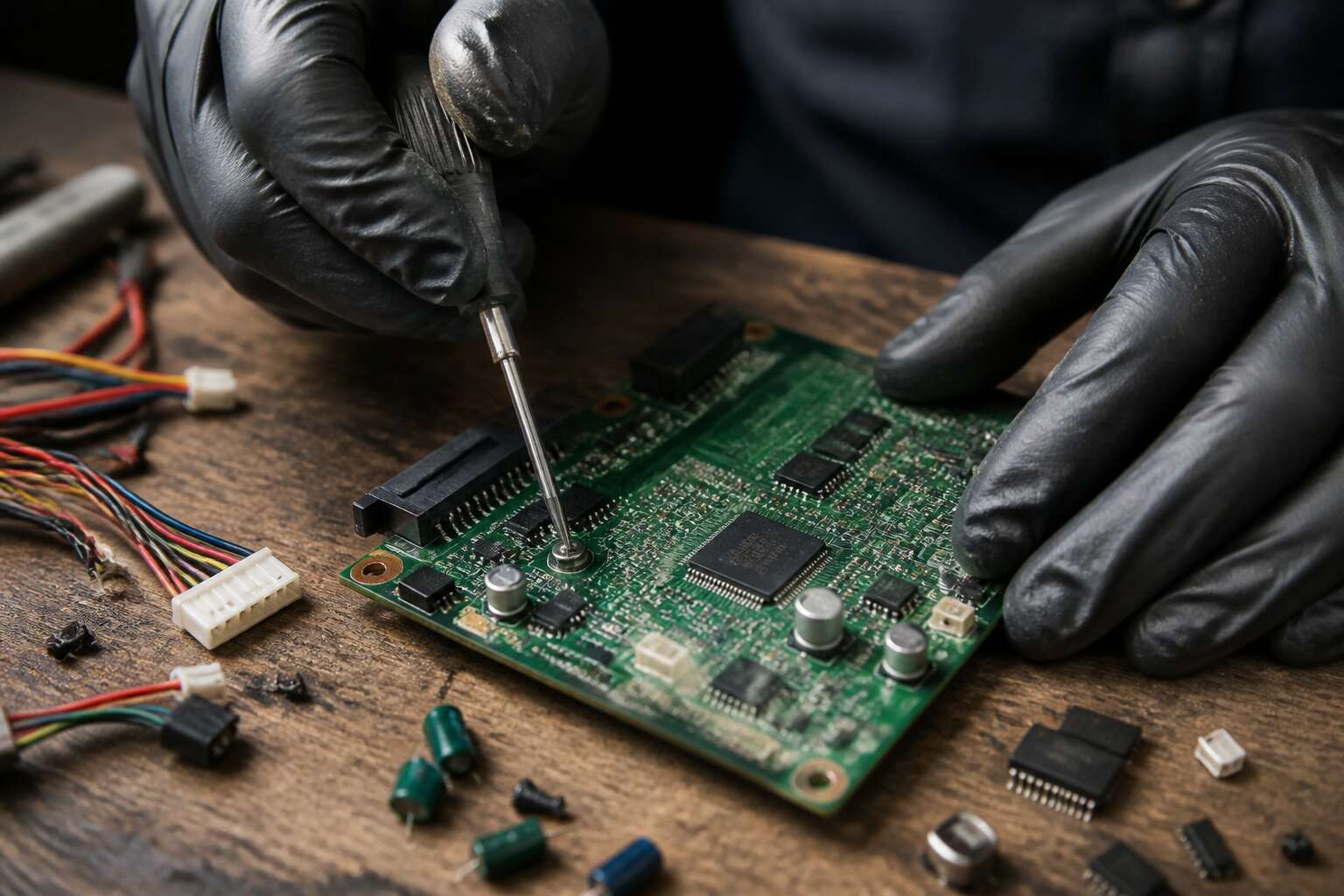
Understanding E-Waste and Its Components
Definition and Scope of E-Waste
South Africa generates more than 360,000 tonnes of electronic waste annually, yet only a fraction of that mass receives safe treatment. E-waste is a broad category. It includes mobile phones, desktop towers, circuit boards, batteries, and cabling. Each component carries distinct materials and distinct risks. Printed circuit boards hold precious metals. Plastic housings contain brominated flame retardants. Cathode ray tubes contain leaded glass. The dismantling of e waste starts with identifying these component types and their hazard profiles. Without this foundation, downstream recovery becomes guesswork.
Understanding the full scope requires sorting e-waste into clear streams:
– Large household appliances such as fridges and washing machines
– Small appliances and IT equipment
– Screens, monitors, and display units
– Cables, adaptors, and embedded power supplies
Each stream demands a different approach during the dismantling of e waste. The scope also extends to the millions of tonnes moved across borders, with much landing in African ports. Recognising what counts as e-waste, and what does not, shapes how operators plan their workflows.
Common Electronic Devices and Their Materials
Think about a desktop PC, still warm from a long day’s work. Its metal case hides a motherboard dense with capacitors and microchips. A phone, smaller than a bar of soap, contains a screen, a battery, and a logic board all fused together. These are not uniform blocks of waste. They are composite objects, and that is the central challenge of the dismantling of e waste. The processes are never about crushing a device wholesale; they are about undoing its construction.
The materials themselves tell the story of the appliance. A refrigerator is heavy with steel and copper tubing, but foam insulation snags the disassembly line. A flat screen monitor is a study in contrasts, with aluminium heat sinks next to fragile glass panels. Precious metals, such as gold and palladium, sit in the pins of connectors, waiting for extraction. This is why the dismantling of e waste is so specific. Success depends entirely on reading the item in front of you and knowing where the value is hidden and where the hazards lurk. For a common mobile phone, the material list alone explains the complexity:
– A lithium ion battery, which requires careful discharge protocols
– A printed circuit board with trace amounts of gold, silver, and palladium
– A magnesium alloy frame or aluminium casing
– A glass touchscreen coated with indium tin oxide
Each layer creates a different requirement for the operator. The battery alone prevents any form of mechanical shredding. The glass requires separation from the LCD panel. The dismantling of e waste is not a brute force exercise. It is a methodical deconstruction that respects the original engineering.
Batteries remain the most volatile component in any device. A single punctured lithium cell can ignite a fire that destroys an entire sorting bay. That is why the first step is often the simplest, which is the removal of the power source. Cabling and adaptors add another layer of complexity, as their copper content is valuable, but the PVC insulation requires granulation to separate the plastic from the metal. The dismantling of e waste is therefore a series of decisions, where each choice about manual versus mechanical separation affects the purity of the final output. The skill is in the identification, not the hammering.
Environmental and Health Risks of Improper Disposal
Every year, millions of electronic items reach the end of their useful lives in South Africa. When these devices are dumped into landfills, their inner components begin a slow chemical breakdown. The dismantling of e waste is the only way to prevent this process from poisoning the ground beneath our feet.
A single discarded monitor contains glass, plastic, and a cathode ray tube with up to four kilograms of lead. Once the casing cracks, that lead does not stay put. Rainwater seeps through landfill layers and creates a contaminated liquid called leachate. This fluid can travel into groundwater and affect drinking water for years.
- Mercury switches in older appliances
- Cadmium in semiconductor chips
- Brominated flame retardants in circuit boards
Informal recyclers often strip components by hand without protection. They breathe in fine dust from broken solder, which contains lead and antimony. Burning wires to recover copper releases dioxins and furans. These chemicals enter the bloodstream and can cause lasting neurological damage. Proper dismantling of e waste reduces these exposures by separating materials in controlled conditions.
Preparing for Safe E-Waste Dismantling
Regulatory Compliance and Certifications
Most people don’t realise that the most dangerous part of electronics recycling happens before a single component is touched. In South Africa, the legal framework around e-waste is tightening, and for good reason. The dismantling of e waste without proper oversight can expose workers to lead, mercury, and brominated flame retardants. That’s why regulatory compliance isn’t just paperwork; it’s a shield. Certifications like ISO 14001 and e-Stewards verify that your facility meets international safety standards. You’ll need a waste management licence, which requires an environmental impact assessment. Here’s what a compliant setup typically involves:
- Sealed work surfaces that prevent dust migration
- Approved bins for hazardous residues like capacitors
- Emergency washing stations for chemical exposure
Each certificate requires ongoing auditing, and that’s a good thing. It forces you to track every gram of recovered material. I’ve seen small operators skip these steps to save time, but they pay dearly when an inspector arrives. The Department of Environmental Affairs doesn’t accept verbal promises. They want documentation, training records, and proof of safe storage. Preparing for these checks isn’t bureaucratic hassle. It’s the difference between a sustainable business and a liability.
Personal Protective Equipment and Safety Protocols
Some operators treat safety gear as an afterthought until a sander slips or a cathode ray tube implodes. In South Africa, the informal sector sees higher injury rates from the dismantling of e waste, but that is avoidable. Personal protective equipment is the first line of defence against heavy metal dust and shattered glass. You cannot rely on a standard dust mask for this work; it filters nothing dangerous. Your workers need a complete kit before they touch a single circuit board:
– Cut resistant gloves with a grip for handling sharp plastic and glass.
– Safety goggles that seal fully around the eyes to block airborne particles.
– NIOSH approved respirators, not surgical masks, for airborne lead and cadmium.
– Steel capped boots for dropped components and compressed CRT glass.
– Coveralls with cuffed wrists to prevent dust settling on skin or clothes.
Beyond the gear, protocols dictate behaviour. Every workbench should have a designated zone for live capacitors and a separate bin for broken glass. Workers must wash hands before eating or smoking, no exceptions. Routine rotation through tasks reduces fatigue, which is when mistakes happen. The dismantling of e waste is manual labour, and your safety plan has to respect that reality. Shouting instructions once during orientation fails. You need daily checklists, visual reminders, and a supervisor who pauses operations when a respirator gets damaged. The gear only works when it is worn, fitted, and replaced on schedule. Comfort matters too, because the heat in Johannesburg or Durban makes workers ditch their gloves if they are uncomfortable. Invest in breathable materials and hydration breaks. A safe facility is a slower facility, but your workforce remains healthy, and your liability drops with every safety check completed.
Tools and Equipment for Dismantling
A screwdriver’s steel tells you everything about a facility’s discipline. In the dismantling of e waste, the wrong tool creates fires, ruined boards, and crushed fingers. Start with precision drivers, side cutters, and a spudger for prying without puncturing batteries. Keep a heat gun for adhesive, but monitor it closely.
- Magnetized trays to track screws
- Insulated pliers for live capacitors
- Hardened cutters for steel cables
Shears and breakers handle larger housings, while a workbench vise stabilises awkward items. Tools must be inspected daily, because a worn tip forces extra pressure, and that pressure causes fractures. Rotate tools between stations, and store them in a lockable cabinet. The right equipment turns manual labour into a controlled process.
Sorting and Categorizing E-Waste Streams
Before a single screw turns, the dismantling of e waste begins with classification. Arriving loads mix cathode ray tubes, lithium cells, and copper wound transformers. Each stream demands a distinct workflow. Sorting by category and hazard level prevents cross contamination and protects workers from reactive battery packs.
A preparation station should separate items into sealed containers by material family. This is where the dismantling of e waste gains efficiency. Boards with gold plated pins move one way. Steel housings move another. Plastics with brominated flame retardants require separate handling.
For a facility in Johannesburg, incoming e waste might include:
- Telecom batteries from backup systems
- Server racks from financial firms
- Refrigerant compressors from retail cooling units
Categorization determines the sequence of disassembly. A CRT monitor and a lithium drone battery share nothing in common. Treating them alike invites disaster. The sorting table is where risk is assigned.
Step-by-Step Dismantling Processes
Disassembling Small Consumer Electronics
When a phone refuses to cooperate, proper technique matters more than force. Small consumer electronics require gentle prying, not crowbar theatrics. Start by removing the battery, as residual charge can turn your afternoon into an unwelcome science experiment. Then work around the edges with a spudger to release plastic clips. This dismantling of e waste prevents hazardous components from ending up in landfills and keeps valuable circuit boards intact.
Once open, follow a logical sequence to avoid damaging reusable parts. A typical order looks like this:
1. Unclamp the screen assembly using a heat gun.
2. Disconnect the display cable, not your inner cowboy.
3. Lift out the mainboard and set aside screws in labelled trays.
4. Separate speakers, cameras, and the haptic motor.
Each screw hidden in a crevice is a key to cleaner South African e waste streams. Tray sorting every metal and plastic keeps the process honest, and future you will appreciate the organisation. Slow, methodical work beats brute force every time.
Handling Batteries and Power Sources
A swollen lithium cell can release enough energy to melt steel. That is why the dismantling of e waste begins with power sources, not logic boards. Batteries deserve caution before any screw turns.
Handling power sources means verifying the device is off. Then detach the battery connector. Capacitors may still hold a charge, so a multimeter check avoids surprises.
- Swelling
- Excess heat
- Leaking residue
These warning signs tell you to stop. Each battery is treated as live until disconnected and discharged.
Extracting Circuit Boards and Processors
The transition from power sources to circuit boards marks the point where dismantling of e waste becomes precise work. Circuit boards carry value beneath layers of solder and conformal coating. Processors sit in sockets or are soldered directly to the board.
Extracting a board requires attention to fastener placement. Ribbon cables lift with a gentle tug on their tabs. Screws come out with the right driver size, never forced. A heat gun softens stubborn solder joints. Pry tools release glued components without scoring the board.
Follow this sequence:
- Remove heat sinks and fans blocking processor access.
- Release socketed processors before touching soldered parts.
- Disconnect ribbon cables at their base, not the wire.
- Desolder through-hole components after the board is free.
A processor lifted cleanly from its socket holds more value than one pried out in haste. The dismantling of e waste at this stage pays off in cleaner material streams.
Separating Plastics, Metals, and Glass
Plastics account for nearly 20% of global e waste by weight, yet they are the most challenging stream to purify. After circuit boards leave the line, the remaining shell demands its own ritual. The dismantling of e waste now shifts to separating plastics, metals, and glass with deliberate force.
Begin by cracking the external casing with a flat pry bar, then remove the metal frame. Glass panels lift free once adhesive strips are scored. For mixed materials, follow this sequence:
- Strip ferrous metals with a magnet before any shredding.
- Separate non ferrous metals like aluminium by hand.
- Isolate glass shards into a dedicated bin immediately.
Plastics from casings often carry metal inserts. A heat gun softens the plastic around these anchors, allowing clean extraction. Glass from screens must never mix with glass from tubes, as the chemical compositions differ! This separation stage determines the purity of every downstream material stream.
Managing Hazardous Materials Like Mercury and Lead
The dismantling of e waste acquires a different rhythm when mercury and lead enter the scene. These materials do not announce themselves with a shout. Mercury hides inside the delicate glass of fluorescent lamps and within the subtle mechanics of tilt switches. Lead lurks in the solder that binds circuit boards and in the heavy glass of cathode ray tubes. The dismantling of e waste becomes an act of reverence, a quiet negotiation with elements that do not forgive carelessness.
Handle these components with a deliberate sequence:
1. Remove all lamps and switches containing mercury before any other disassembly step.
2. Place them directly into sealed, shatterproof containers.
3. Extract leaded glass from CRT screens using a dedicated chisel, never a hammer.
4. Store lead-contaminated components in clearly labelled, impermeable bags.
The work demands patience. A single mercury spill can render an entire workspace hazardous for years. Lead dust settles into every crevice, invisible and persistent. Each movement in the dismantling of e waste must be measured, for these materials remember every mistake. The reward is a safer facility and a cleaner stream of recovered resources.
Data Destruction and Storage Media Handling
Hard drives in a salvage bin are a legal problem. In South Africa, the Protection of Personal Information Act demands physical destruction of storage media. The dismantling of e waste requires a deliberate ritual when memory chips enter the picture.
Follow a ruthless order in the dismantling of e waste:
- Isolate every storage device before cracking a single case.
- Degauss magnetic drives until their data is unreadable.
- Shred solid state drives into fragments smaller than a fingernail.
- Record serial numbers and issue a destruction certificate.
Never ignore embedded memory. Smartphones and printers hide storage in unlikely places. A hammer leaves recoverable shards. The sequence exists because data remains after casual attempts. Respect that reality, or you will explain to regulators why your old server now helps someone else access your accounts.
Maximizing Recovery and Recycling Efficiency
Identifying High-Value Components for Resale
Each motherboard and processor holds latent value that often goes unrealized. While bulk scrap has its place, the real profit in the dismantling of e waste lies in the meticulous extraction of specific components. Gold plated pins, copper coils, and high grade capacitors are not generic refuse. They are commodities that command a premium on the secondary market when sorted correctly. A worker who takes the time to separate these items from the general plastic and steel stream performs a crucial economic function.
To genuinely maximize recovery, a facility must prioritize component identification before the crushing phase begins. It is a simple calculation. A fully intact CPU sells for more than a shredded one. The process demands a sharp eye and knowledge of what buyers are currently seeking. For example, commercial server RAM or industrial grade connectors are consistently in demand, whereas older consumer audio chips may not be worth the extraction time.
Recycling efficiency improves when you know exactly what you are looking for. Here is a practical breakdown of common high value targets:
– Precision ceramic capacitors, often found near power regulators.
– Solid state drives with intact memory modules, provided they are data wiped.
– Tantalum capacitors, sometimes mistaken for generic resistors.
– Copper wiring wound into larger gauge bundles, not the thin strands.
By moving these categories into dedicated bins immediately, you reduce the volume of material sent to the smelter and increase the yield of your dismantling of e waste operations. This targeted approach turns a routine disassembly line into a profitable and resource efficient hub, which is essential for the growing electronics recycling sector in South Africa.
Techniques for Precious Metal Recovery
Precious metal recovery starts long before any acid bath or smelter. The dismantling of e waste with precise separation preserves the tiny gold traces and palladium layers that make modern electronics worth the effort.
My favorite technique is a two stage sorting process. First, separate boards by age and type. Second, apply selective leaching only to high grade boards. That cuts chemical use by half!
- Use nitric acid for base metal removal, not whole board digestion.
- Employ electrolytic recovery for gold from plating solutions.
- Test for silver with a simple chloride titration before bulk processing.
These techniques produce predictable yields for the operation.
Recycling Plastics and Non-Metallic Materials
Plastics make up roughly a fifth of the weight in most discarded electronics. Yet during the dismantling of e waste, these materials often get overlooked once the valuable metals are pulled. That is a missed opportunity.
The key is to sort plastics by polymer type before shredding. Acrylonitrile butadiene styrene, or ABS, appears frequently in monitor housings. Polycarbonate shows up in laptop shells. When these streams stay pure, they fetch far better prices from local recyclers in South Africa.
Consider this approach:
- Remove metal inserts and labels before granulation
- Use density separation to isolate polypropylene from mixed residues
- Shred plastics to a consistent chip size to improve melt quality
Foam rubber, glass fibres and epoxy dust require different handling. They are not all recyclable, but knowing which fractions hold value changes the economics of the entire dismantling of e waste process.
Responsible Handling of Glass and Cathode Ray Tubes
Glass from monitors and televisions often contains lead, especially in cathode ray tubes. That makes the dismantling of e waste more demanding than pulling apart a plastic housing. Many South African recyclers skip this fraction entirely, leaving hazardous cullet in landfills.
To maximize recovery, separate the funnel glass from the panel glass. They have different chemical compositions. The funnel glass holds around 20% lead by weight. The panel glass carries barium and strontium. Mixing them ruins the value of both.
- Inspect each tube for cracks before handling.
- Use a wet saw to cut the neck and funnel sections.
- Vacuum away the phosphor coating after removal.
I have seen facilities double their glass recovery revenue by testing for lead content on site. A simple XRF gun gives instant readings. That data helps you batch materials for smelters that accept leaded glass. Remember, the dismantling of e waste is not complete until every hazardous component is neutralized.
Partnering with Certified Refiners and Recyclers
Partnering with certified refiners and recyclers turns the dismantling of e waste into a revenue generator. These processors recover gold, palladium, and copper from fractions you cannot refine on site. They hold the permits required to move hazardous material across provincial borders.
I have watched operators lose margin selling mixed shred to the first buyer who made an offer. Certified refiners publish transparent assay sheets. They pay on verified content, not on trust. Build relationships with three outlets so a single price cannot dictate your margins!
Before signing a contract, confirm:
- A valid waste management licence under NEM:WA
- Third party audit of the recovery process
- Written settlement terms for each metal stream
Traceability matters. Certified refiners record every kilogram in and gram out. That audit trail protects you from liability. The dismantling of e waste ends only when materials reach a facility equipped to handle them safely.
Economic and Environmental Impact of Proper Dismantling
Cost-Benefit Analysis of Formal vs Informal Dismantling
In South Africa, the choice between formal and informal dismantling of e waste changes the economic equation. Formal operations invest in ventilation, secure storage, and certified disposal, raising immediate costs but reducing future liability. Informal dismantling appears cheaper, yet it leaves contaminated ground and blocked drainage.
Formal dismantling delivers a higher return per tonne. The cost benefit analysis hinges on these points:
- Proper separation of materials for resale.
- Access to certified buyers.
- Avoidance of legal penalties.
Informal operations skip these steps, but their environmental impact surfaces as poisoned water and medical bills.
Creating Circular Economy Opportunities
Every tonne of discarded electronics holds a secret ledger, one that records either profit or long term loss. The dismantling of e waste, when executed with precision, transforms a tangle of broken components into a stream of recoverable assets. In South Africa, this process is not merely about prying apart plastic and metal. It is about capturing the embedded value of gold from pins, copper from windings, and rare earth elements from magnets before they vanish into landfill.
Proper dismantling of e waste secures these materials for direct reintroduction into manufacturing supply chains. This is the engine of a circular economy, where yesterday’s obsolete motherboard becomes tomorrow’s smartphone casing or industrial connector. The economic impact is tangible, measurable in every rand reclaimed from a discarded circuit board.
– Material purity increases, commanding higher prices from certified refiners.
– Valuable components avoid the grinder, retaining their functional worth for resale.
– Toxic fractions are isolated, eliminating costly environmental remediation later.
The environmental impact follows the money. When dismantling of e waste is done correctly, the hazardous burden never touches the soil or the water table. The heavy metals are contained, the brominated flame retardants are managed, and the greenhouse gas emissions from virgin mining are avoided entirely. This is the quiet machinery of value recovery, and it operates best without the spectacle of scavenging. The true cost of e waste is not in its collection, but in the discipline of its disassembly.
Future Trends in E-Waste Processing Technologies
The true cost of our digital existence is only now becoming legible. The dismantling of e waste operates at the intersection of salvage and stewardship, where the discipline of the process dictates whether we profit or poison. Automated shredding lines offer speed, but they pulverise the very value we seek to reacquire. The future belongs to selective disassembly, where robotic vision systems identify gold-laden pins and rare earth magnets before the blade ever falls. This precision is not a luxury; it is the primary determinant of yield.
Consider the economic ledger. When dismantling of e waste is performed with surgical intent, the recovered fractions command a premium that bulk recycling cannot touch. The separation of copper windings from steel cores, the careful extraction of lithium cells, and the isolation of palladium capacitors all feed distinct refining streams. These are not commodities; they are concentrated revenue events.
– The purity of separated streams reduces the energy cost of refining.
– The resale of functional components bypasses the smelter entirely.
– The liability of hazardous residue is neutralised at the source.
Environmental trends are accelerating in lockstep with automation. Cryogenic grinding, which embrittles materials for cleaner separation, is now paired with density sorting to recover plastics without contamination. Pyrometallurgical recovery is being tempered by hydrometallurgical baths that operate at ambient temperatures, slashing the carbon footprint of metal extraction. The dismantling of e waste is evolving from a manual trade into a data driven science, where every gram of material is logged, valued, and routed.
We are moving toward a closed loop where the motherboard you discarded in Johannesburg becomes a verified input for a factory in Cape Town. The chain of custody, once opaque, is now transparent through blockchain ledgers that trace each component from bin to buyer. This visibility is reshaping the economic incentives, rewarding operators who prioritise traceability over volume. The machinery grows smarter, but the moral imperative remains human. Each board we disassemble is a promise that obsolescence is not an ending, but a quiet metamorphosis.
Can we disaggregate the device from the consequence of its disposal? The answer lies in the granularity of our methods. The future of dismantling of e waste is not in faster destruction, but in slower, more deliberate revelation of the resources trapped within. The cycle tightens, and the margin for error shrinks.


0 Comments